


 From the Lab,News
A model that works: what the ekip Academy showed about building innovation ecosystems
From the Lab,News
A model that works: what the ekip Academy showed about building innovation ecosystems
A model that works: what the ekip Academy showed about building innovation ecosystems
By Katerina Kalimera
There is a particular kind of problem that no single organisation alone can solve, no matter how capable. The problems Europe is facing now, technological, social, environmental, are all of that kind. And the reflex, increasingly, is to reach for innovation as the answer. The trouble is that we have been reaching for a very narrow version of it: innovation understood as technology, infrastructure, engineering – a version with no obvious place for culture and the people who make it.
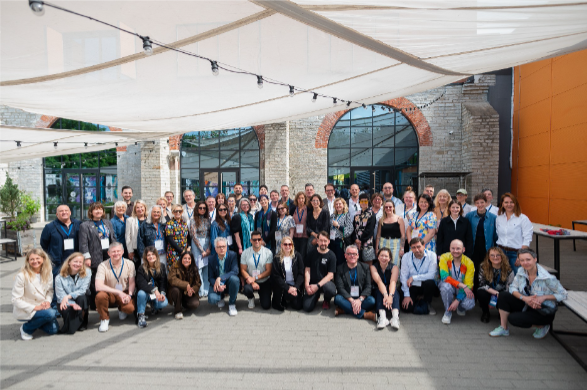
For four days this June, in a former industrial complex in Tallinn, the ekip Academy brought together multidisciplinary teams from across Europe to learn how to design innovation strategies that integrate Cultural and Creative Industries into broader innovation ecosystems. It is a training programme developed by the ekip consortium for teams of policy actors, innovation practitioners, and creative professionals working on shared local challenges. Rather than arguing why this approach matters, the Academy demonstrated it. Having watched how it was built and what it produced, it is worth stepping back to connect the dots: between what ekip is, what happened in that room, and why the result matters beyond the fourteen teams who were there.
The premise: creatives are the missing piece
ekip, the European Cultural and Creative Industries Innovation Policy Platform, begins from a diagnosis that is easy to state and uncomfortable to sit with. Look at innovation policy across the last several decades, and the cultural and creative industries have been quietly written out of it, treated as decoration rather than as core actors, even though creative professionals have always been part of how innovation happens. The Academy is built around a simple idea: putting creatives back where they have always belonged, at the heart of innovation processes.
That claim rests on a specific idea about how creatives function in a system. They are, as one contributor described it, the sense-makers, not there to decorate the world but to get to the root and truth of it. They translate complexity, build trust, and make new ideas make sense to people who would otherwise never engage with them. The recurring image throughout ekip’s work is the swarm: an individual creative is easy to overlook, but a swarm, like bees, moves together and changes what is possible. The challenge for Europe, in ekip’s framing, is not a shortage of creativity but a shortage of connectivity. The talent is already here, what is missing is the activation.
The method: open innovation, practised rather than
described
What makes the Academy worth writing about, from a communications point of view, is that its form is its argument. ekip did not lecture on open innovation and cross-sector collaboration. It engineered the conditions for both and let participants experience what they produce.
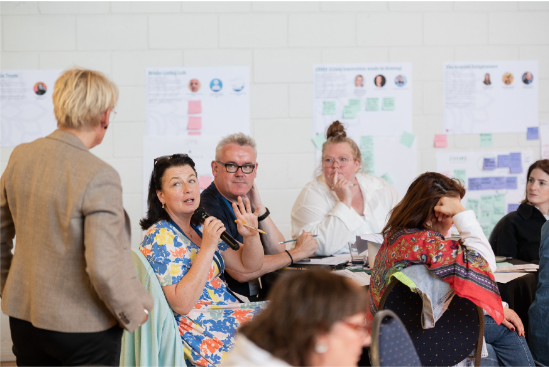
The design was deliberate down to the composition of each team. Fourteen ecosystems were selected, each sending a team of three: a policymaker, a creative entrepreneur, and an innovation facilitator, drawn from the same region. From the first hour, people were collaborating with colleagues from disciplines they did not share and, often, had not previously met. That friction is the point. As one of the facilitators observed, putting people in a room who are unfamiliar with each other’s disciplines lets them create something they simply could not produce alone in their familiar environments – and it is precisely the thing that the day-to-day of being a policymaker, or working in the creative industries, never allows time for.
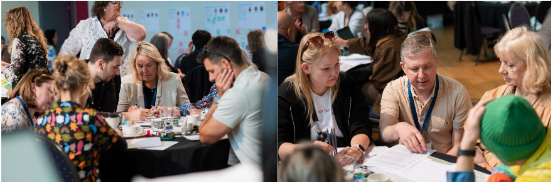
The environment reinforced the method. The Academy was held at Telliskivi Loomelinnak, a creative city built inside old factory buildings that has become one of Europe’s clearer proofs of what a cultural community can do for a place, and a reminder that this was a working example of the very thing under discussion, not a neutral conference venue. The facilitators were explicit that the real work does not begin in the boardroom. It starts, as one put it, at the pub or over dinner, in the social spaces where unexpected conversations happen and a creative spark can turn into something with impact. You cannot do that online always, you must meet.
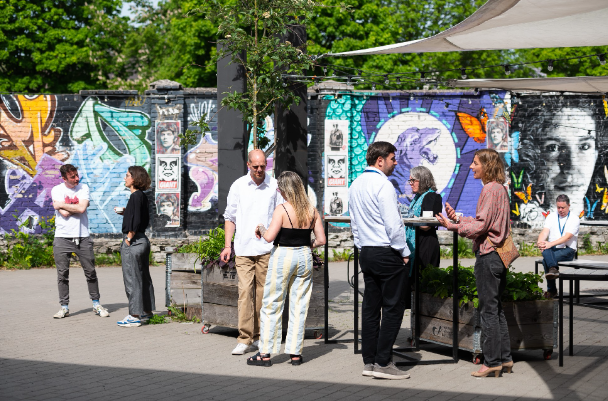
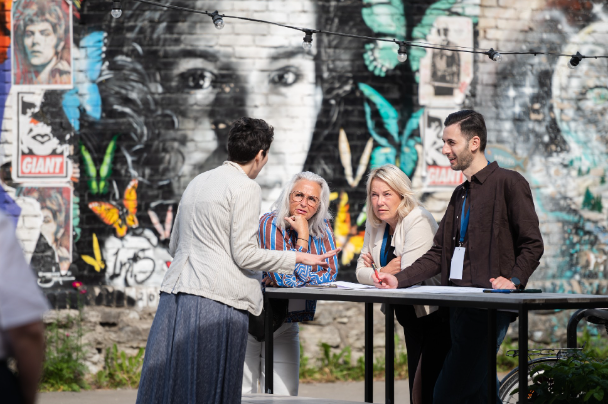
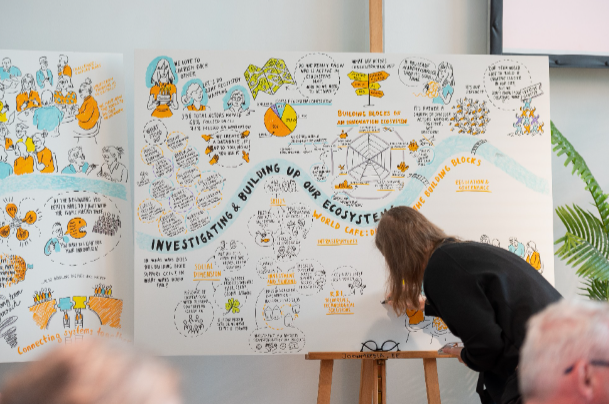
This matters because it inverts the usual logic of a training programme. Rather than presenting a fixed curriculum, the Academy was designed as an exchange. Throughout the four days, participants worked with the ekip methodology for understanding innovation ecosystems, identifying ecosystem building blocks, mapping local contexts, exploring future scenarios through back casting, and developing innovation portfolios. At the same time, every team contributed to its own experiences, questions, and local realities. The learning travelled in both directions, and both directions were load bearing.
Curious about the methods used throughout the Academy? Explore the ekip Knowledge Bank for explanations of the innovation building blocks, ecosystem mapping, back casting, portfolio development, and other tools used during the programme.
What the room revealed
Watching fourteen ecosystems work out the same problems at once produced a kind of live map of where Europe actually stands.
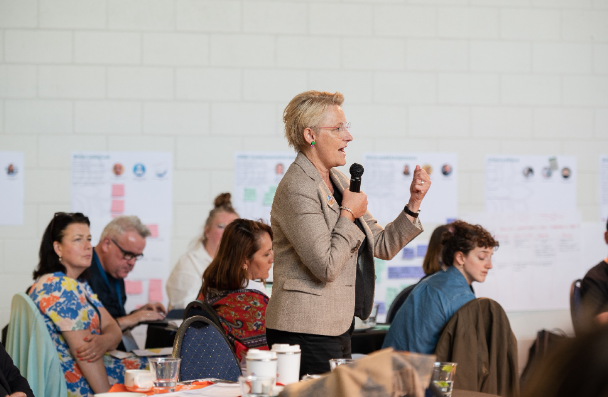
The diversity of Europe’s ecosystems was visible and honest. Asked to plot their timelines, some teams measured the short term in months and others in years, the same wall, seen from very different distances. A regional ecosystem like the Basque Country, with years of experience developing its approach, sat alongside teams working to connect people, organisations, and institutions around shared innovation goals for the first time. Rather than treating these differences as a gap, the Academy turned them into a strength. Every ecosystem had something to contribute, and every ecosystem had something to learn.
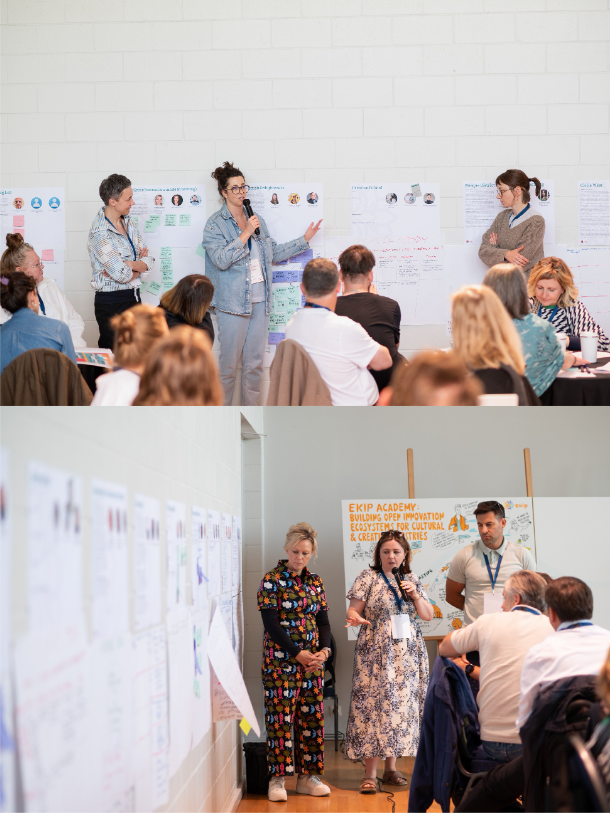
The hard questions were allowed to stay hard. The conversations around the “building blocks” of an ecosystem, competitiveness, governance, skills, infrastructure, funding, kept converging on a single word: translation. How do you translate innovation concepts into language cultural organisations actually use? How do you translate what a creative does on the ground into something a funding instrument can recognise? The funding discussion circled the knot that everyone wants results and no one wants risk, with the role of the intermediary still undefined. The skills discussion surfaced real pressure and fear, because asking a sector to build new capabilities is never a neutral request. The Academy’s contribution was to make these things sayable, collectively and hold them in the same space, which is the necessary precondition for anyone solving them at all.
And a recurring, quietly radical reframe ran underneath all of it: the answer to “what if there is no ecosystem where we are?” was never to build one from scratch, but to look again, to define the scope of a challenge, take an inventory of the actors already nearby and internationally, and begin the deliberate journey of mobilising them. The ecosystem, in other words, is usually already present. What has been missing is the cohesive force to see it and set it in motion.
Why it matters now
The clearest signal came after the Academy ended and we are not very surprised by it. Demand has already outrun supply: what began as fourteen teams is expected to grow toward twenty, as other cities and regions move to repeat the model. The interest was always there; what ekip supplied was something concrete for that latent need to attach to. After three years of the project and the completion of this first Academy, the conclusion its coordinators draw is simple and, on the evidence, earned: the model works.
For those of us who work in communications, there is a lesson from Tallinn that goes far beyond cultural policy. It is about how real alignment is created. You can repeat the same message again and again until people understand it, but understanding runs much deeper when you create the conditions for people to arrive at the same conclusion themselves. That means bringing together the right people, giving them a shared challenge, taking them out of their usual environments, and creating enough space for conversations, trust and new relationships to develop. The ekip Academy was designed to do exactly that. As several facilitators reflected, the most valuable conversations begin after the Academy ends. That is because the real outcome was never the four days themselves. It was the relationships, ideas and momentum that those four days set in motion.
Europe’s creative and cultural industries have spent a long time as the missing piece in innovation policy. What the ekip Academy demonstrated is that the piece is not missing at all. It has simply been waiting for a structure capable of connecting it to everything else – and for the recognition that, without that cross-sector collaboration, none of the challenges ahead of us get answered.
Latest ekip News and Updates
October 1, 2026
Europe has the pieces. In Eindhoven, ekip shows how to connect them.
On 23 October, during Dutch Design Week, three years of European work on the cultural and creative industries changes hands ...
September 17, 2026
By Michalis Stangos
Four things Europe needs to get right on the creative industries, and one that is still missing
Europe is losing the technology race, but it still leads on creativity. China used to recruit European engineers. ...
September 3, 2026
By Lena Holmberg, Lund University
AI and CCI: Shaping Europe’s Next Step
Across Europe, cultural and creative actors are asking a similar question: how can artificial intelligence be shaped in ways that strengthen creativity, cultural diversity and democratic innovation, r...
July 16, 2026
By Katerina Kalimera
Translators, mediators, connectors: the missing infrastructure of innovation
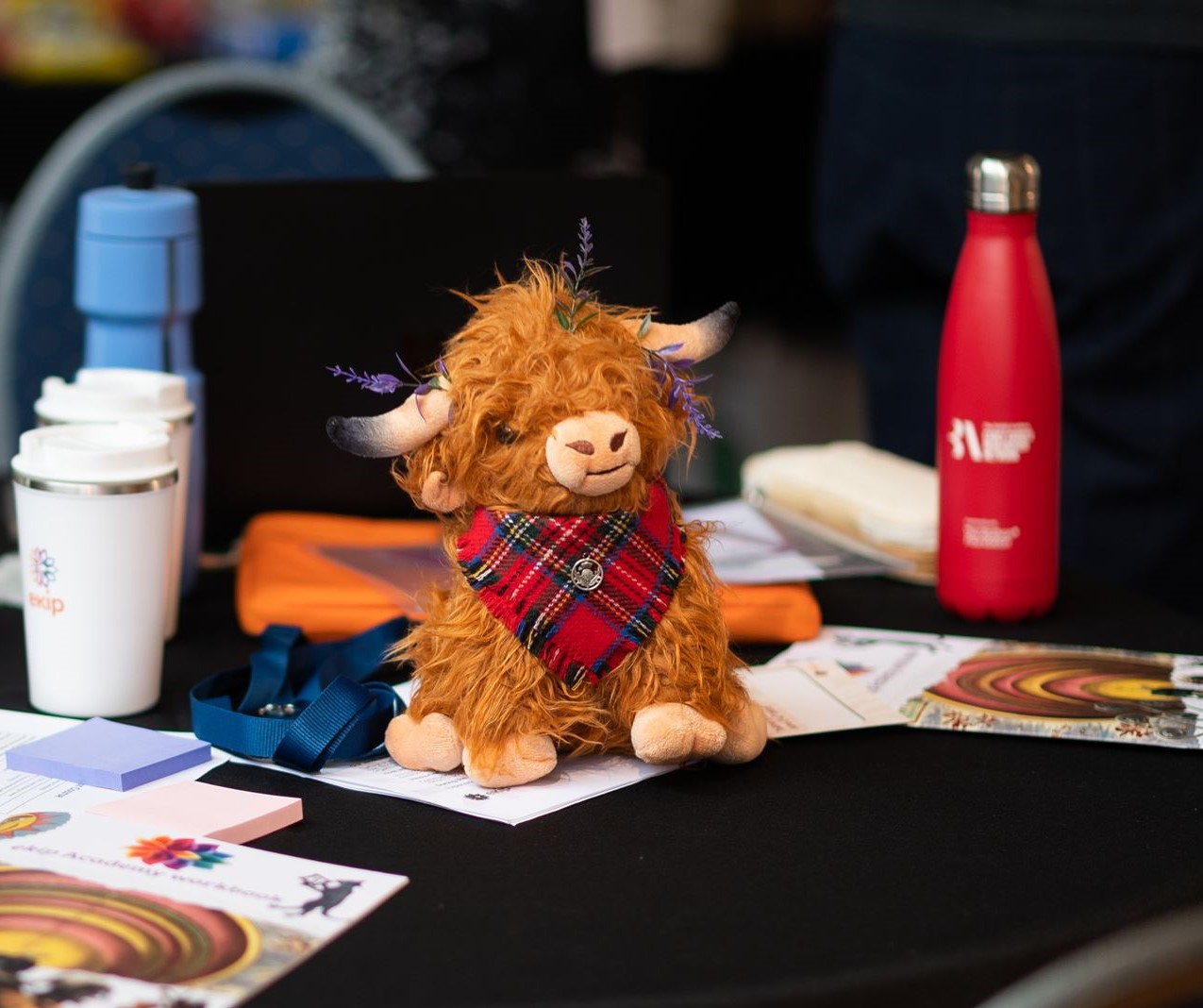
At the ekip Academy in Tallinn, the South of Scotland team described themselves as the “glue” forming sectors and enabling collaboration, a basic idea that stayed with attendees throughout the event....
