


What Should Europe Do Next?
Let’s make sure that Europe’s most powerful asset for competitiveness will be a driver across ecosystems!
For all the language of competitiveness and technological sovereignty, Europe’s innovation policy still underuses one of its strongest capabilities: its Cultural and Creative Industries (CCIs). Not as a niche sector, but as a force shaping how innovation happens.
If Europe is serious about future-ready innovation ecosystems, CCIs must move to the core. That requires structural change across five fronts put forward by ekip.
Five recommendations for the EP and Council
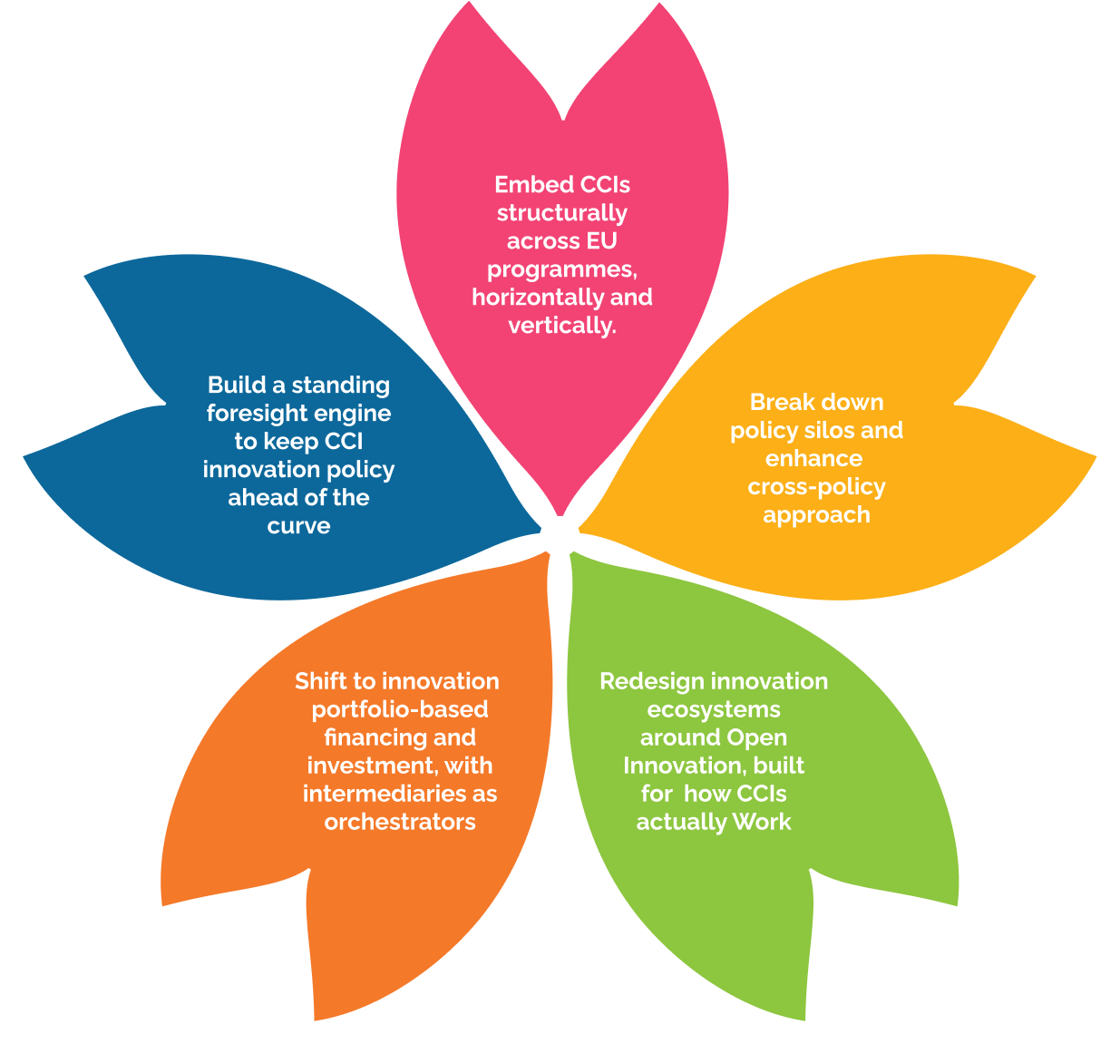
- Embed CCIs structurally across EU programmes, horizontally and vertically. Cultural and Creative Industries are not a niche add-on, but a strategic capability for Europe. Require their systematic integration across FP10 and relevant MFF in how programmes are designed, governed, and implemented. This means both horizontal integration across all innovation domains and vertical integration, as in Cluster 2, within key value chains, so CCIs can develop on their own terms while driving change in other sectors.
-
Break down policy silos and enhance cross-policy approach.
Europe’s cultural and innovation policies still run in parallel tracks. To change this, we need concrete bridges, both conceptual and structural. Concepts such as “innovation by (cultural) production” give CCIs a recognised and powerful role within innovation frameworks. Paired with joint priority- setting and combined funding structures at EU and Member State level, these tools make co- designed, cross-policy programmes possible and lasting.
-
Redesign innovation ecosystems around Open Innovation, built for how CCIs actually Work.
CCIs do not innovate in straight lines. They work through networks, experimentation, iteration, and collaboration: a creative swarm logic that traditional innovation systems were not built to support. Redesign the building blocks of European innovation ecosystems, including funding, infrastructure, skills, and regulation, around Open Innovation as a guiding principle, so CCIs have the capacity and the environment to contribute fully.
-
Shift to innovation portfolio-based financing and investment, with intermediaries as orchestrators.
Move from fragmented project funding to coordinated, multi-stakeholder innovation portfolios that make transformative and radical innovation possible. This requires both the right structures, with strategic intermediaries who connect CCIs, academia, industry, and society, and the right instruments: dedicated financing mechanisms with appropriate risk appetite, blended finance models, and value metrics that treat creativity-led innovation as the strategic investment it is. Intermediaries and investors must both be recognised and resourced accordingly.
- Build a standing foresight engine to keep CCI innovation policy ahead of the curve. Innovation policy that reacts is already behind. Europe needs a continuous, collaborative foresight capacity: structured policy journeys that bring together CCI communities, researchers, industry, and public actors to anticipate challenges, identify opportunities, and translate them into action. This is not a one-off process. It is a living, demand driven engine that keeps ecosystems adaptive, policy accurate, and Europe’s creative advantage actively in play.
Explore the full report below, featuring the five recommendations in three formats, a concise version, an extended version, and a 10-year vision, alongside summaries of the event sessions and insights from the guests and friends who contributed to the discussions. Together, these conclusions, reflections, and recommendations provide a comprehensive overview of how innovation ecosystems can be advanced through the Cultural and Creative Industries.
