
Welcome to the new innovation policy platform for the cultural and creative industries

- POLICY AREAS
 AI and Cultural and Creative Industries
 New European Bauhaus – CCIs enabling green transition
 Immersive Media
 Crafts-led Innovation
 Platformisation of the Music Industry
 Inclusivity in Video Game Industry
 Cross-Innovation with Performing Arts
 Fashion Transition: Eco-Design for Circularity
 Cultural Heritage Institutions within Open Innovation Ecosystems
 New funding models for creativity and innovation
 Spaces, infrastructures, and ecosystems for CCIs

The challenge isn´t creativity but connectivity
By Bodil Malmström

The creative and cultural industries (CCIs) are vibrant, innovative and central to a dynamic society. Yet despite their economic value and cultural importance, they often operate within systems that struggle to support their growth and integration into wider innovation ecosystems.
From design studios and architecture firms to fashion, digital creation, theatre and film, CCIs are rich in ideas and experimentation. However, they are frequently misunderstood especially when it comes to scalability and collaboration beyond their own sector.
“It’s a sector with a lot of small companies, and they’re used to being extremely creative,”
says Charlotte Lorentz Hjorth, Coordinator of ekip.
“But when it comes to scaling up, the structure around them isn’t built for it.”
Innovation in isolation
The challenge isn’t creativity – it’s connectivity.
Many creative entrepreneurs are highly educated in their craft and form companies with peers who share similar artistic values. Unlike tech startups, however, they rarely bring in commercial roles such as CFOs, marketers or product managers early on.
“You are so shaped by your own identity, deeply embedded in your business idea,”
says Charlotte Lorentz Hjorth.
“It’s your own creation. It should last all the way.”
This strong personal connection to creative work can make partnerships feel risky, especially when tools, frameworks or trusted intermediaries are missing.
The role of intermediaries
A major obstacle for CCIs is the lack of structural support. While tech startups benefit from incubators, accelerators and investors fluent in scaling, CCIs often navigate fragmented landscapes alone.
This is where intermediaries innovation hubs, cultural institutions, municipalities and universities become critical.
“It’s not always about joining an incubator,” says Charlotte Lorentz Hjorth.
“Sometimes what’s needed is a space where people from different fields can meet, collaborate and learn.”
Open innovation approaches help move the focus from individual company growth to partnership-driven innovation, creating shared frameworks for collaboration across sectors.
Scaling the swarm
CCIs don’t operate like traditional industries. They function more like swarms: decentralized, agile and project-based. Yet funding and policy structures are still designed to support single, scalable entities.
“We need to make the swarm logic visible,” urges Charlotte Lorentz Hjorth.
“If we keep supporting just the individual organization, we’ll never unlock the full potential of these micro-enterprises.”
The answer lies in distributed support systems that strengthen creative clusters networks of companies, universities and institutions that co-create value together. Examples already exist in places like Future by Lund in Sweden and Cike in Slovakia.
Toward a co-creative future
The future of CCIs depends on ecosystems that recognize and nurture collaboration rather than competition.
“What we see is an opportunity to use creatives’ own ways of working but within a new regulatory framework,”
says Charlotte Lorentz Hjorth.
By embracing swarm logic and flexible partnerships, innovation ecosystems can evolve into mobile, adaptive networks where each project fuels the next.
“The innovation ecosystem of the future will not consist of large, fixed colossi,”
she concludes.
“It will be flexible networks, constantly moving forward without borders.”
What needs to change?
To unlock the full potential of the CCI sector, several shifts are required:
- Intermediary infrastructure
Support structured spaces for open innovation physical and organizational where creatives can experiment, collaborate and scale.
- Cross-sector partnerships
Embed CCIs into partnerships with public institutions, universities and large companies, recognizing creative expertise as essential.
- Policy shift
Move from “supporting” creatives to co-creating with them. Concepts such as Innovation by Production can guide this transition.
- Recognition of innovation
Redefine innovation beyond patents and technology. Cultural, experiential and systemic innovations matter.
- Cultural change in institutions
Governments and academia must loosen rigid structures and allow more room for experimentation.
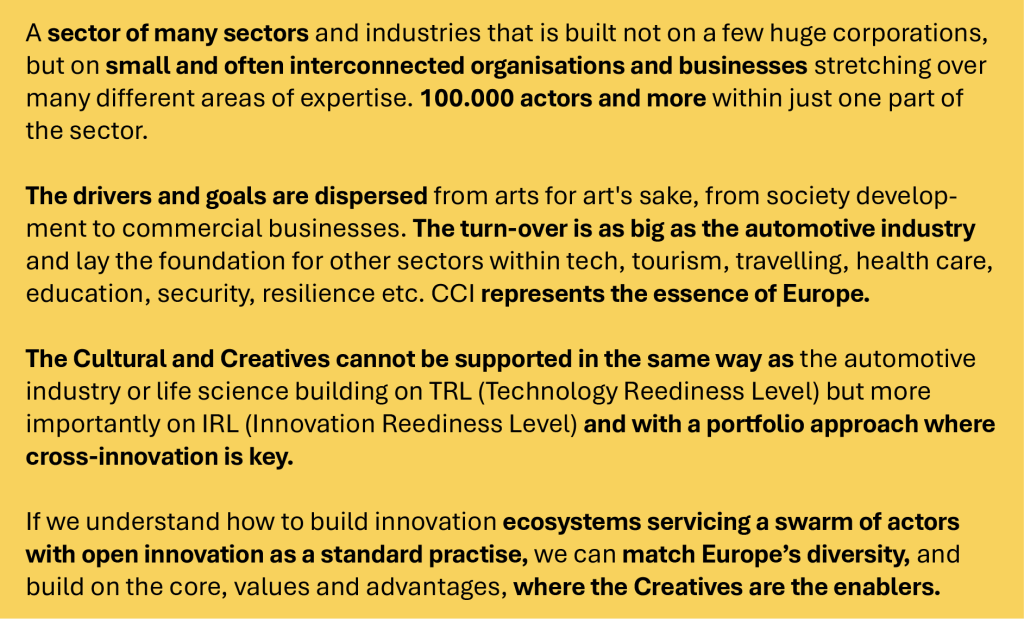
FACTS
Latest ekip News and Updates

June 1, 2026
By Bodil Malmström
Innovation reshapes cultural and creative industries, opening new funding and business models
Cultural and innovation policy are increasingly interconnected in shaping the future of creative industries....

May 20, 2026
By Bodil Malmström
Where Art Meets Algorithms: New Frontiers in Deep Tech and the Creative Industries
As Europe accelerates its push into deep tech, Finland is emerging as a driving force in connecting it with the Cultural and Creative Industries. ...

May 20, 2026
By Bodil Malmström
ekip: a project that became a journey
From early ideas to European influence, Rickard Bucksch, ekip’s former Policy Officer at the European Commission’s DG Research and Innovation, reflects on a journey shaped by collaboration, experiment...

April 16, 2026
By Bodil Malmström
From Fabric to Future: How DPP is Transforming European Fashion
The transition toward a circular and sustainable fashion industry is gaining momentum across Europe, driven by both environmental urgency and evolving policy frameworks. ...
