


Redesigning Europe: The Dutch lessons
By Paul Hekkert (Opinion column)
Europe’s cultural and creative industries have the skills to help tackle society’s biggest challenges. The task now is to embed these capabilities in the research, innovation and competitiveness programmes shaping the continent’s future.
In 2010, something began to shift in the Netherlands. At Delft University of Technology, increasing numbers of industrial design students were turning away from careers centred on industry and consumerism. Instead, they wanted to use their skills to build a better, fairer and more sustainable world. The talent was already there. What needed to change was its purpose.
Around the same time, the Dutch government designated the creative industries as one of nine priority sectors in its economic strategy. Gaming, digital design, architecture and other creative disciplines were recognised not simply as cultural assets, but as a professional community with the potential to contribute to society.
A few years later, the two developments converged. Sector-based economic policy gave way to a mission-driven approach focused on challenges such as healthcare, climate and energy, security and food production. This opened up new opportunities for creative professionals to work across traditional sector boundaries and contribute to societal transformation.
Their ability to imagine alternative futures, engage people in change and translate ideas into solutions made them valuable innovation partners. Not everyone in the Dutch innovation ecosystem was immediately convinced, but a decade of collaboration helped establish creative expertise as an increasingly indispensable part of the process.
The results range from improving the final mile of public transport and constructing buildings from mycelium to opening up the Rijksmuseum’s collections through digital technologies. Creative professionals have also helped rethink mental healthcare, explore regenerative agriculture, improve patient flows in hospitals and strengthen communication between doctors and patients.
The Dutch experience offers lessons for Europe at a critical moment.
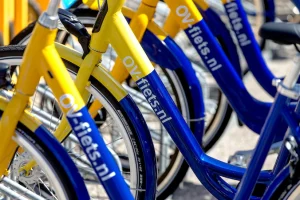
The OV-fiets is the Netherland’s popular public bike-sharing scheme, allowing travellers to rent a bicycle easily at railway stations and use it for the last leg of their journey.
Reason for being
Now, Europe is at a crossroad. Geopolitical changes have forced us to get our act together, rely on our own strength and values, and secure a safe, just, democratic, clean, healthy –also economically–, and attractive Europe, a place where everyone wants to live, where the well-being of all citizens comes first. As Draghi put it, “Europe’s fundamental values are prosperity, equity, freedom, peace, and democracy in a sustainable environment. The EU exists to ensure that Europeans can always benefit from these fundamental rights. If Europe can no longer provide them to its people – or has to trade one for the other – it will have lost its reason for being.”
To preserve and further create this Europe, we need to innovate; to design and develop new services, platforms, systems and products that contribute to the kind of Europe we cherish and protect with everything we hold dear. More people, from policy makers to academics, politicians, and other thought leaders, are convinced that the cultural and creative industries are crucial for this: we need their competences, skills and creativity to stay competitive and innovate responsibly and with care.
Stronger position for the creatives
The way this belief in the power of culture and creativity is proclaimed depends on the perspective of the messenger. And there are three lenses in this playing field: the societal challenges lens, the creative sector lens, and the innovation ecosystem lens.
First, if you work in the public sector at a national or EU level, your aim is or should be to improve society by accelerating transitions. Technological breakthroughs are your main hope, and increasingly, you admit we need culture and creativity to provide purpose and direction, and to ensure there is broad support among citizens. If you are part of the CCI sector, your main objective is to create as much leeway as possible for creative SMEs and professionals to contribute and flourish. Finally, people active in city or regional innovation ecosystems want their systems to be as innovative and successful as possible. They see creatives as a welcome and necessary partner and try to create optimal conditions for them to join.
Over the past year there have been numerous reports, posts and letters about the position of the CCI in European policy and programs. The consistency in the messages is: we need the CCI sector for value-driven innovation and citizen engagement, we need culture and creativity to guide Europe towards “an independent, prosperous, secure and thriving society and economy over the coming decade” (MFF). At the same time, there is plenty of worry about the role creative professionals may play in the innovation and competitiveness agendas, and confusion as to the diversity and uniformity within the sector. To help establish a stronger position for the cultural and creative industries across European programmes, from the Competitiveness Fund to FP10, three important lessons should be taken into account:
The Creative Industries are conditional for innovation and economic growth in a thriving, inclusive, and democratic Europe.
Technology and technological developments are indispensable for innovation, as are social knowledge and public values. All these disparate aspects must converge in interventions and applications, and creative professionals are uniquely trained to achieve this integration; they master the HOW. Creative professionals bring in methods, skills, and competencies that are fundamental to socio-technical (or integral) innovation. The creative industries are ideally suited to link technological possibilities to European public values such as democracy, equality, well-being, and sustainability, thus ensuring that competitiveness and societal change go hand in hand.
Sustainable public-private partnerships take place in R&I ecosystems—and these must be optimized for the CI.
The anchoring of the creative industry in societal innovation requires a sustainable ecosystem in which collaboration between all parties—and the role of the creative professional—is optimally utilized. Research and innovation ecosystems are characterized by public-private partnerships between knowledge institutions, the public sector (city, region), industry, and creative SMEs. Such R&I ecosystems are increasingly central to European policy, and ekip is committed to making them optimally accessible to the CCI by formulating and testing policy recommendations around the key building blocks of these ecosystems.
The Creative Industries, unity-in-diversity.
Creative professionals share an important quality: they use creativity to create value for people, society and thus the industry. This justifies speaking of a single professional group or sector. At the same time, there are significant differences within that group. Traditionally, we think of different disciplines that manifest themselves in distinct end products (such as film, architecture, performing arts, or digital design). Increasingly, however, CPs are withdrawing from this categorization by emphasizing the hybrid nature of their work. Furthermore, the manifestation in societal innovation is subordinate to the goal: social impact or transformation. Therefore, it is more informative to differentiate between the attitudes, skills, methods, and competencies that CPs use to create value.
Better ways of integrating
Creative professionals bring a broad range of capabilities to innovation. They put people and society at the centre, drawing on insights from the social sciences and humanities. They give meaning and direction to technological development, reframe challenges and imagine desirable futures. They also shape and orchestrate innovation processes, turn ideas into practical interventions that encourage new behaviours, integrate public values and engage stakeholders and citizens through participation and co-creation.
Creative professionals vary in the extent to which they possess and can apply these skills and competencies, and societal issues/transitions can vary in the degree to which certain skills or competencies are required. This fact should be reflected in differentiated cultural and innovation policies and hence, with these three lessons, we build the necessary bridge between cultural policy and innovation policy.
In sum, Europe does not only need more recognition of the cultural and creative industries; it needs better ways of integrating creative capabilities into the research, innovation and competitiveness systems where Europe’s future priorities are being shaped.
All of this to fervently support ekip’s first recommendation: Embed CCIs structurally across EU programmes, horizontally and vertically. Cultural and Creative Industries are not a niche add-on, but a strategic capability for Europe. Require their systematic integration across FP10 and relevant MFF in how programmes are designed, governed, and implemented. This means both horizontal integration across all innovation domains and vertical integration, as in Cluster 2, within key value chains, so CCIs can develop on their own terms while driving change in other sectors.
Paul Hekkert is chair of ekip’s board of validators and former captain of science of the Dutch top sector for the creative industries.
Latest ekip News and Updates

November 10, 2026
By Katerina Kalimera (MSCOMM), based on research by Dr Anna Kallen Talley (Institute for Design Informatics, University of Edinburgh)
From Shared Knowledge to Collective Impact: Connecting Europe’s Creative Ecosystems
How do we make sure that the knowledge generated across Europe creates opportunities for different initiatives to connect, collaborate and co-create?...
November 10, 2026
By Paul Hekkert (Opinion column)
Redesigning Europe: The Dutch lessons
Europe’s cultural and creative industries have the skills to help tackle society’s biggest challenges....
October 28, 2026
By Bodil Malmström
“Culture can provide a kind of glue between technology and society”
Digital commons thrive on sharing knowledge, culture and building communities, rather than innovation for its own sake. ...
October 18, 2026
By Lena Holmberg
AI scraping hits heritage
Cultural heritage institutions are struggling with a surge of commercial AI scraping....
