
- ABOUT US
- OBSERVATORY
- CORE CONCEPTS
- ekip ENGINE
- POLICY AREAS
- Policy Documents
- AI and Cultural and Creative Industries
- New European Bauhaus – CCIs enabling green transition
- Immersive Media
- Crafts-led Innovation
- Platformisation of the Music Industry
- Inclusivity in Video Game Industry
- Cross-Innovation with Performing Arts
- Fashion Transition: Eco-Design for Circularity
- Cultural Heritage Institutions within Open Innovation Ecosystems
- New funding models for creativity and innovation
- Spaces, infrastructures, and ecosystems for CCIs
- Reimagining Deep-Tech
- Digital Commons
- KNOWLEDGE BANK
- NEWS
- COMMUNITY


- ABOUT US
- OBSERVATORY
- CORE CONCEPTS
- ekip ENGINE
- POLICY AREAS
- Policy Documents
- AI and Cultural and Creative Industries
- New European Bauhaus – CCIs enabling green transition
- Immersive Media
- Crafts-led Innovation
- Platformisation of the Music Industry
- Inclusivity in Video Game Industry
- Cross-Innovation with Performing Arts
- Fashion Transition: Eco-Design for Circularity
- Cultural Heritage Institutions within Open Innovation Ecosystems
- New funding models for creativity and innovation
- Spaces, infrastructures, and ecosystems for CCIs
- Reimagining Deep-Tech
- Digital Commons
- KNOWLEDGE BANK
- NEWS
- COMMUNITY
Core Concepts
The work in ekip rests on core concepts that shape its activities and outputs. Together, these concepts show what is distinctive about ekip: a foresight-driven policy-development approach that combines open innovation, CCI expertise, ecosystem activation, city prototyping and portfolio thinking to turn policy recommendations into shared action. ekip aims to create a common language and support structure that enables the transformation of entire areas, while recognising cultural and creative actors as active drivers of innovation. That is why common definitions matter.
The core concepts are presented below with links to relevant articles and reports.
INNOVATION
READ MOREProactive innovation policies have been implemented in different forms for a long time, including before the concept became widely used and popular. The Encyclopedia Britannica article sums up ‘innovation’ as “the creation of a new way of doing something”, whether concrete or abstract, a new product or a theoretical approach to a problem. While innovation takes place in all walks of life, the ekip project is rooted in the perspectives of business management and innovation. This is also the source of most innovation parlance. Indeed, as a term, innovation is probably most conventionally connected to business development and often intertwined with terms such as ‘efficiency’ and ‘productivity’, economy-laden objectives that ‘innovation activity’ is typically expected to generate.
Innovativeness and innovation are generally considered critical business competences. Over the last decades, ‘innovation’ has grown into a line of industry in itself that lives off the insatiable appetite of business – and also other economic – development investments in innovation. This development has contributed a lot of innovation jargon, but also sincere attempts to describe circumstances and processes that relate to innovativeness and innovation.
OPEN VS CLOSED INNOVATION
READ MOREOpen innovation in ekip refers to a participatory, multi-stakeholder approach in which actors with a shared interest in an overall outcome collaborate across organisational and sectoral boundaries. In an open innovation process, collaborative relationships are established with relevant stakeholders so that different forms of knowledge, expertise and capacity can contribute to a shared goal. The motivation for partners to engage is their common interest in the outcome. When well-coordinated, this work can turn a group of creatives into a creative collective.
ekip adopts this participatory approach to formulate policy recommendations and create a replicable instrument that can guide and engage a variety of actors in policymaking practices. Open innovation is based on a more open knowledge landscape, where information, methods and resources can move across sectors, organisations and markets. It encourages frameworks that engage stakeholders as active participants in an innovation process and helps create ecosystems that resonate with the values and needs of their actors.
Closed innovation, by contrast, is more relevant in organisational or corporate settings where there is a need to protect intellectual property rights, confidential information or business competences. In a closed innovation framework, an organisation relies primarily on its own resources. Compared with open innovation, this can make costs and risks more concentrated within one organisation rather than shared across several stakeholders.
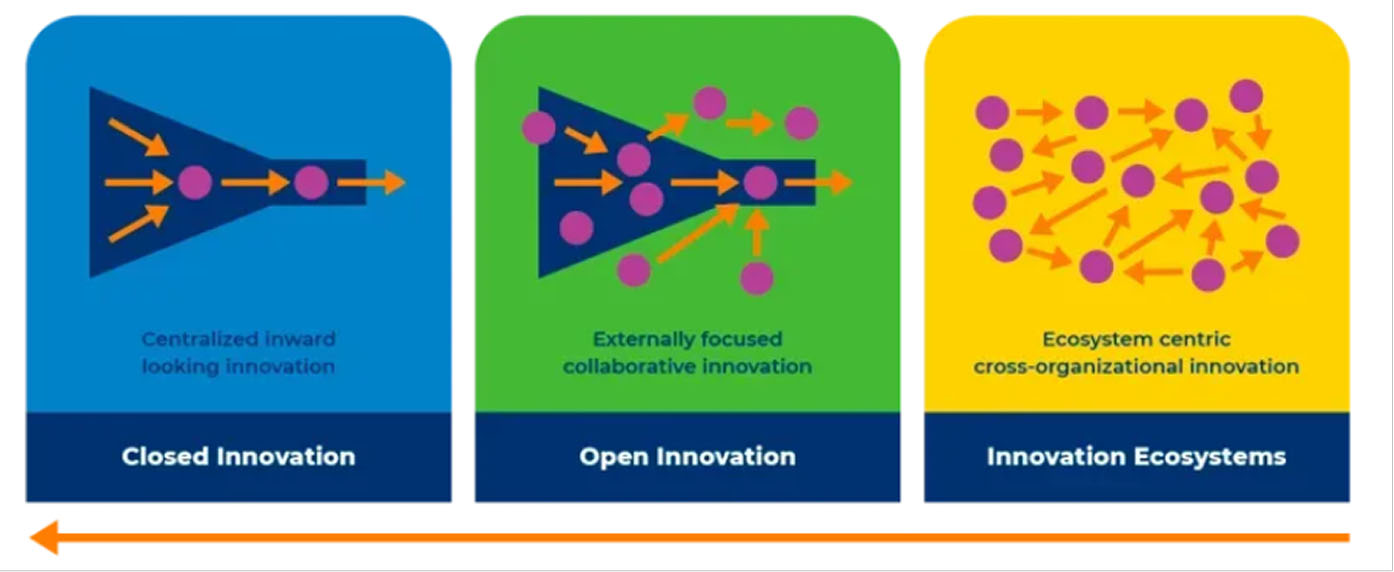
Read more in the ekip article Europe’s music sector must embrace open innovation to compete globally, the white papers Open Innovation 3.0: Empowering Europe Through Cultural and Creative Industries and Innovation By, For, and With the Culture and Creative Industries, The Zone Model, and the LIEPT model.
CROSS-INNOVATION
READ MORECross-innovation in ekip refers to innovation that emerges when cultural and creative industries collaborate with actors from other sectors, disciplines and policy fields to generate new knowledge, methods, solutions and forms of value. It is not simply the transfer of creative ideas into external domains, but a reciprocal process in which artistic, scientific, technological, social and policy-related expertise are brought together around shared challenges. In the performing arts, for example, cross-innovation can involve theatre, dance, opera or immersive live experiences working with research, technology, education, health, urban development or public engagement.
The value lies in how different forms of knowledge interact: artistic experimentation, real-time interaction, audience engagement and embodied practice can help reframe problems, test new methods and create solutions that extend beyond the cultural sector. For ekip, cross-innovation is therefore a way to position CCIs as active partners in research and innovation ecosystems, rather than as peripheral contributors or communication channels.
Read more in the ekip article Cross-innovation with performing arts.
RESPONSIBLE INNOVATION
READ MOREResponsible innovation asks how innovation can be developed in ways that are trustworthy, accountable and genuinely beneficial for those involved. It is especially important when innovation crosses sectors, brings together unevenly resourced actors, or affects communities, rights, values and cultural expression. When innovation is defined mainly in terms of technology and economic growth, major societal opportunities may remain untapped and cultural sectors can struggle to gain equal recognition.
In ekip, responsible innovation is relevant to cultural heritage, music, digital concerts and wider CCI-related open innovation. It emphasises participation, fairness, trustworthiness, accountability and genuine benefit, while recognising that cultural and creative actors should not be reduced to instruments for external innovation goals. Strengthening research and innovation capacity therefore means embedding responsibility in everyday practice, not treating it as something triggered only by a project grant.
Read more in the ekip articles From Culture for the People to Culture with the People, Bringing Communities Together to Tackle Complex Challenges, The music industry – towards a fairer tune, Digital concerts raise new legal questions and Open Innovation and Ethics – A Matter of Trustworthiness, Accountability, and Genuine Benefit for Those Involved.
CULTURAL AND INNOVATION POLICY
READ MOREAlthough cultural policy and innovation policy may appear to follow different logics, they overlap in important ways. Innovation policy is typically oriented towards novelty, scalability and economic impact, supporting new technologies, services, solutions or business models that can be developed, repeated and sustained over time. Cultural policy, by contrast, focuses on the conditions that enable culture to thrive: infrastructure, participation, access, artistic expression, heritage, inclusion and the values that shape cultural life.
A key difference concerns the question of what is supported and who is allowed to participate. Innovation policy often supports ideas, inventions or solutions as they move towards application, intellectual property, market development or wider uptake. Cultural policy is more explicitly concerned with access and legitimacy: who can shape cultural programmes, use cultural infrastructure, receive public support and influence the cultural and social values that society chooses to uphold.
Eligibility and legitimacy are important parts of this process. Governments, funders and cultural institutions often determine who can shape cultural programmes, access funding or use cultural infrastructure. These decisions influence not only which actors are supported, but also which cultural values, communities and forms of expression are made visible.
This difference also reflects distinct understandings of value. Cultural work is often driven by public, artistic and social values rather than by profit, and cultural organisations may operate within non-commercial logics that make financial sustainability difficult. At the same time, innovation has always been present in cultural and creative industries, even when it has not been fully recognised by mainstream innovation systems. Bridging cultural and innovation policy can therefore help make visible the innovative capacity of culture while ensuring that innovation remains connected to societal purpose, diversity and long-term public value. For ekip, the intersection between cultural policy and innovation policy is therefore not only a matter of aligning two policy fields. It is a way to strengthen the role of cultural and creative industries in wider transformation processes, build more inclusive innovation ecosystems and develop policies that support both societal benefit and creative capacity for future generations.
Read more in the ekip articles Understanding cultural policies and innovation policies: differences, overlaps, and societal benefits, Creatives are in Europe’s Strategies, Now Comes the Hard Part and Creatives Overlooked in National Innovation Strategies, and the white papers Stop Putting on Acts, Make a Difference! Time to (Finally) Frame Policies for Culture, Creativity and Innovation and CCI Policy Landscape Analysis.
INNOVATION ECOSYSTEMS
READ MOREAn innovation ecosystem is a dynamic network of actors, resources, institutions, infrastructures and relationships that enables innovation to emerge, develop and travel. It is often connected to a specific geographical place or area, but it can also include wider cross-sectoral and cross-border relationships. Unlike a biological ecosystem, an innovation ecosystem does not simply exist by itself; it is formed, supported and strengthened through collaboration, knowledge sharing and co-creation among actors with different roles and capacities.
Innovation systems are usually understood as more structured and institution-oriented, including actors such as industry representatives, public administration bodies, development agencies and university research centres. Innovation ecosystems place stronger emphasis on diversity, interaction and emergence. They make it possible to view networks of actors and stakeholders as more complex, open-ended and relational, while still recognising that enabling conditions, infrastructures and governance matter.
In the context of the ekip project, open innovation ecosystems are interpreted as:
- multi-stakeholder environments;
- focused on cross-organisational and cross-sectoral collaboration;
- designed to co-create shared value through radical change in complex transitions and themes.
Read more in the ekip article Building Innovation Ecosystems – The Case for Intermediaries.
INNOVATION ECOSYSTEM BUILDING BLOCKS
READ MOREDriving innovation across sectors and borders requires a shared foundation. ekip develops innovation policy recommendations that address innovation ecosystem building blocks: the key factors an ecosystem needs in order to perform. Currently, ekip uses the following building blocks, resonating with frameworks used in research and development: infrastructures and networks; investment and funding; regulation and governance; skills and competences; the social dimension; sustainable competitiveness; and techniques and technologies. Together, they show how innovation capacity depends not only on ideas, talent or technology, but also on the wider conditions that allow collaboration, experimentation, scaling, inclusion and long-term transformation to take place.
Read more in the ekip article Boosting innovation across sectors and borders and Innovation Ecosystems Building Blocks.
FORESIGHT-DRIVEN POLICY DEVELOPMENT
READ MOREPolicy development often starts with agenda setting, followed by formulation, adoption, implementation and evaluation. Foresight-driven policy development expands this sequence by asking not only what policy should respond to today, but also what futures it should help make possible. It uses scanning, sensemaking, scenario thinking, backcasting and stakeholder dialogue to identify emerging trends, weak signals, future needs and possible transition pathways before they become fixed policy problems. Rather than predicting one future, foresight helps policymakers and ecosystem actors explore several plausible futures, test assumptions and identify strategic options under uncertainty. It therefore turns policy development from a mainly reactive process into a more anticipatory, adaptive and learning-oriented practice.
In ekip, this approach is used to connect cultural and creative industries more systematically to green, digital and social transitions. The ekip Engine brings together policymakers, CCI actors, researchers, intermediaries, cities and innovation practitioners to explore future challenges, translate them into policy areas and develop recommendations that can be tested, refined and mobilised across innovation ecosystems. Foresight is therefore treated as part of the policy-development journey itself: it links horizon scanning and shared sensemaking to policy formulation, prototyping, implementation and evaluation. This helps ensure that recommendations do not become static outputs, but living frameworks that can be adapted as new knowledge, partnerships and contextual conditions emerge. In this way, foresight supports policy that is anticipatory, actionable and grounded in the creative capacities of the sectors and places it is intended to support.
Read more in the ekip articles Boosting Europe’s Creative Future: Inside ekip’s Prioritisation Phase and Policy, policy recommendation, policy area, and policy development journey – what’s the difference?
THE SWARM
READ MOREIn ekip, the swarm describes the way cultural and creative industries often organise and innovate: not as a single, linear value chain or a set of large, scalable firms, but as a decentralised, agile and project-based network of creators, micro-companies, organisations and intermediaries. Like a bird swarm, the strength lies in coordinated movement across many independent actors. Ideas, skills and relationships are mobilised temporarily around productions, challenges or opportunities, then reconfigured as new collaborations emerge. This makes CCIs highly adaptive and rich in experimentation, but also difficult for conventional innovation systems to recognise and support.
The policy challenge is therefore not a lack of creativity, but a lack of connectivity. If funding, incubation and innovation policy are designed mainly for individual companies that scale in predictable ways, the distributed capacity of the swarm remains invisible. Supporting the swarm means building connective infrastructure: trusted intermediaries, meeting places, shared frameworks, open innovation processes, and policy instruments that enable actors from CCIs, research, business, municipalities and civil society to collaborate across sectors. For ekip, making the swarm logic visible is essential for turning the diversity of Europe’s creative capacity into collective innovation power.
Read more in the ekip article The Challenge Isn’t Creativity but Connectivity.
INNOVATION BY PRODUCTION
READ MOREInnovation by production refers to innovation that emerges through the process of producing artistic or creative work. Rather than treating production as the final delivery stage, the concept understands rehearsal, composition, scenographic development, technical problem-solving, adaptation, audience interaction and live performance as environments where new knowledge, methods, tools, formats and relationships are generated. In performing arts and other cultural and creative industries, productions bring together distributed expertise under uncertainty and constraint, allowing artists, technicians, designers, producers, institutions, audiences and external partners to solve artistic, organisational and technological problems in real time. These processes may generate technical, material, methodological, social, organisational, experiential and societal innovation, even when they are not planned or labelled as innovation.
Because this knowledge is often tacit, embodied, situated and relational, it may disappear when a production ends unless it is documented, translated and connected to wider innovation ecosystems. This is also why CCI-related open innovation needs special attention: support systems must be able to recognise what has been learned through production, broker collaboration across sectors, and create pathways for responsible transfer without reducing artistic production to a mere instrument for external innovation goals.
Read more in the ekip articles CCI: Many inventions, but little innovation and Put Performing Art on the Innovation Map.
INNOVATION PORTFOLIO
READ MOREAn innovation portfolio approach creates movement and transformation across an area that is broader than any single organisation, individual or project. Instead of expecting one initiative to deliver one innovation, a portfolio gathers several related experiments, prototypes, partnerships and investments around a shared transition challenge. Its value lies in nurturing a palette of innovations that can complement, learn from and strengthen one another over time. Some activities may test new technologies, others may develop new collaboration models, funding mechanisms, audience formats, policy tools or forms of public engagement. Together, they create a distributed learning environment where uncertainty can be managed, different pathways can be explored and emerging insights can be redirected as conditions change.
For ekip, this is particularly relevant when working with CCIs, because creative capacity is often distributed across many actors and does not usually move through one linear pipeline. A portfolio approach therefore helps connect smaller initiatives into a more strategic whole, making it possible to support transformation while still allowing diversity, experimentation and adaptation.
Read more in the ekip articles Innovation Portfolios Pave the Way for Collaborations with the Creatives and Reinventing the live music experience – through collaboration.

How ekip Supports You
Why is ekip for me?
ekip helps policymakers, creatives, and ecosystem actors design better innovation systems—starting with culture and creativity.
Take me to: ekip Engine
Am I part of the creative and cultural industries (CCIs)?
If you work in culture, creativity, or across sectors—yes. We include designers, artists, researchers, museums, start-ups, public agencies, and more.
Learn more: ekip Knowledge Bank
What's my role in the open innovation ecosystem?
Our personas page helps you find your role within the innovation ecosystem. Whether you're a policymaker, cultural practitioner, researcher, or city stakeholder.
Explore personas: Page coming soon...
What does "open innovation" mean in ekip?
In ekip, open innovation means starting with collaboration, not competition. We focus on early-stage, cross-sector work where diverse actors (including creatives) frame problems, test ideas, and shape policy together. It's not about keeping solutions proprietary—it's about building ecosystems where innovation grows through shared knowledge and trust.
Learn more: ekip Tools and Methods
What can ekip help me do?
Whether you're shaping policy or leading a project, ekip gives you practical tools, stories, and tested methods to support inclusive, cross-sector innovation.
Start here: ekip Tools and Methods
What can I achieve here?
Learn from real-world innovation ecosystems across Europe; from cities to labs to creative sectors. Discover tested strategies, policy recommendations, and examples of what works (and what doesn't) in building inclusive, cross-sector innovation.
View cases and recommendations: Page coming soon...
Where can I find data, trends, or resources?
Our Knowledge Bank collects case studies, tools, and practical guidance you can apply to your own context.
Visit the KB: ekip Knowledge Bank
How do I avoid repeating what's already been tried in innovation policy?
Check our real-life examples from cities and labs to see what innovation policy actions and interventions have already been tested, and what impact they had.
Explore city cases: ekip Knowledge Bank
How can I implement something like this in my city?
Start with our Policy Lab and City Prototyping guides—tested methods for working with creatives in local innovation.
Get guidance: ekip Tools and Methods
Who can guide me through the innovation process?
ekip tools and labs are co-created by experts across Europe. You can follow their methods,or connect with our community.
Connect with us: About ekip
How can I join the ekip network?
Our Community space is open to collaborators, creatives, and policymakers. Register to take part.
Join the platform: My Creative Networks
How can I contribute or share my work?
You can share resources, ideas, or event opportunities directly in our community or get in touch with the team.
Start contributing: My Creative Networks
What is a policy lab?
A policy lab is a co-creation space where diverse actors shape practical innovation policy ideas together.
Learn more: ekip Tools and Methods
What is city prototyping?
It's how ekip tests policy ideas in real local contexts—through workshops, experiments, and collaboration.
See examples: ekip Knowledge Bank