


 Big Ideas & Perspectives,News
From Shared Knowledge to Collective Impact: Connecting Europe’s Creative Ecosystems
From Shared Knowledge to Collective Impact: Connecting Europe’s Creative Ecosystems
By Katerina Kalimera (MSCOMM), based on research by Dr Anna Kallen Talley (Institute for Design Informatics, University of Edinburgh)
How do we make sure that the knowledge generated across Europe creates opportunities for different initiatives to connect, collaborate and co-create?
Impact grows when European initiatives connect with their expertise, compare findings, and share practical approaches. As knowledge travels between them, it finds new life with different audiences and perspectives and contributes to more connected policy discussions.
ekip, the European Cultural and Creative Industries Innovation Policy Platform, is rooted in open innovation. It brings together broad stakeholder groups to co-create and deliver evidence-based policy recommendations. Part of that process means looking outward: learning from other initiatives working in the same field and sharing what ekip has developed in return.
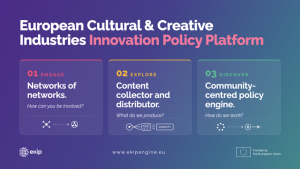
Over three years, ekip directly collaborated or took part in knowledge exchange activities with other EU-funded initiatives and organisations focusing on cultural and creative industries (CCIs) and EU policy, including the Creative FLIP project and the EIT Culture & Creativity North-West Regional Hub. Knowledge rarely stays where it was made; like a river, it gathers strength from every tributary it meets and carries something of each one further downstream. Through a series of interviews carried out by Dr Anna Kallen Talley with representatives of these initiatives, two forms of impact emerged: impact through connecting policy perspectives and impact through method transfer and network-building.
Case study 1: Creative FLIP – Impact through connecting policy perspectives
Creative FLIP stands for Finance, Learning, Innovation and Intellectual Property Rights for the Cultural and Creative Sectors and Industries (CCSI). The project, which ended in 2026, aimed to support healthy and sustainable ecosystems for Cultural and Creative Industries (CCIs). Creative FLIP and ekip shared a partner organisation, IDEA Consult, and Creative FLIP was familiar with ekip’s programmes, methods and policy recommendations. But most importantly, both projects shared the ambition to inspire EU policymakers to strengthen the position and resilience of CCIs in Europe.
Bringing together two policy perspectives
Cultural policy and innovation policy are often designed in different ministries, with different budgets and by different communities of experts. Cultural policy protects, sustains and promotes artistic expression, through measures such as arts funding, heritage protection and EU programmes like Creative Europe. Innovation policy stimulates economic growth, increases productivity, and solves structural problems through technological or systemic change, through research funding, innovation agencies and programmes like Horizon Europe.
At first glance, they seem to operate from different starting points, with distinct priorities and measures of success. Look closer, however, and their paths begin to converge: both shape the conditions in which cultural and creative organisations operate, collaborate and grow.
This matters because many creative organisations sit between the two. A design studio developing a new material, or a games company testing immersive technology, is innovating, yet it can be too commercial for most cultural funding and still not recognised as innovation by innovation programmes.
The collaboration between Creative FLIP and ekip created an opportunity to bring these perspectives together. While Creative FLIP focused on cultural policy and strengthening the resilience of the cultural and creative sectors in Europe, ekip brought an innovation policy perspective, helping broaden the discussion around the role of CCIs in European innovation ecosystems.
From knowledge exchange to policy development
The collaboration created a two-way exchange between complementary policy perspectives.
In March 2026, ekip’s Policy Corner on New funding models for creativity and innovation was organised alongside Creative FLIP’s Community of Practice (CoP) on Resilient CCS Ecosystems at Goethe-Institut Brussels. The invitation-only event welcomed over 40 participants from European CCI networks, intermediary organisations, other EU-funded projects, academia and policymaking to discuss Creative FLIP’s findings and draft policy recommendations for strengthening the resilience of CCIs in Europe.
During the lunch break, participants could visit the ekip Policy Corner to provide input and exchange with ekip colleagues from Politecnico di Milano, who moderated the session. Next Atlas’ social listening analysis for ekip was also presented during the event, confirming several findings from Creative FLIP’s analysis of finance in the cultural and creative sectors and providing additional validation.
The discussions at the CoP informed Creative FLIP’s final study [1].
Creative FLIP, in turn, helped ekip bring its policy work into an established CCI community. Following the Policy Corner, ekip’s Policy Lab on New funding models for creativity and innovation received further input through a community review at the Creative FLIP conference in Brussels on 9 June 2026, where participants discussed and refined recommendations in this area.
The community review helped ekip sharpen its funding recommendations and connect them to practical needs. Participants called for stronger evidence of how CCIs create value, drawing data beyond the sector’s own reflections and recognising cultural as well as economic impact. They encouraged more specific recommendations that build on existing financing instruments, take a 5-10 year perspective, and support different phases of innovation. Learning also needs to go both ways: creative professionals need greater financial knowledge, while investors need a better understanding of creative work and appropriate investment conditions. Participants highlighted how creative hubs and intermediaries could help organisations access funding and develop within supportive ecosystems. They also warned that established networks can be difficult for newcomers to enter, reinforcing the importance of open participation, trust, and collaboration.
Overall, the collaboration was a two-way learning process, helping both projects with “validating or nuancing” their understanding of innovation and financing in the context of CCIs.
Extending the reach of research and insights
Collaboration also took place through the projects’ respective online platforms: Creatives Unite for Creative FLIP and the ekip Knowledge Bank for ekip. Both networks promoted insights, research, and other information from the projects.
Examples included the FLIP transformation policy paper [2] and information about ekip’s Policy Lab on immersive technology, shared on Creatives Unite[3]; and an interview with ekip partner Ragnar Siil (CLAB) was also published on Creatives Unite as part of Creative FLIP’s Talking Finance series [4].
Beyond these activities, a 2024 study of policy and social concepts for the European Parliament’s CULT Committee[5], led by IDEA Consult, took into account insights from both ekip and Creative FLIP. Both projects were mentioned in the report.
Why policy communities need each other
Cultural and innovation policies often operate in separate silos, despite shaping the conditions in which Cultural and Creative Industries develop and grow. By bringing in the innovation policy perspective, ekip highlighted the role of CCIs in innovation ecosystems and informing Creative FLIP’s transformation policy work. The two projects combined their work and addressed policymakers across cultural and innovation policies rather than working within separate policy silos. Their complementary perspectives offered a way to strengthen the relevance and impact of their work towards policymakers.
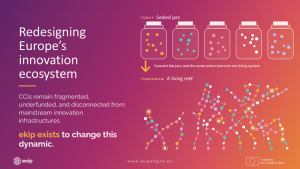
Looking ahead: Connecting policy and creative communities
Creative FLIP noted that innovation is “still for many [cultural and creative actors] something that is not in their vocabulary yet”. This collaboration enriched Creative FLIP’s partners’ perspective on the relationship between cultural and innovation policy, and the necessary development of ecosystem building blocks in the spirit of open innovation in order to create space for cultural and creative sectors to engage in innovation. While ekip primarily engages with policymakers, Creative FLIP has laid the groundwork for connecting with creatives as well as cultural policymakers. Looking ahead, these two stakeholder networks could be leveraged together to create further impact for CCIs, connecting policy perspectives with the communities those policies aim to support.
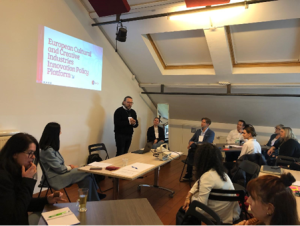
Policy Lab, 9 June 2026.
While Creative FLIP demonstrates the value of connecting policy perspectives, the collaboration with EIT Culture & Creativity North-West Regional Hub shows what can happen when projects share the methods behind their work.
Case study 2: EIT Culture & Creativity North-West Regional Hub – Impact through method transfer and network-building
The EIT Culture and Creativity KIC is an institutional partnership supporting Europe’s CCIs to become more sustainable, resilient and competitive, with multiple hubs throughout Europe. A mutual connection between ekip partner the Netherlands Institute for Sound and Vision and the EIT Culture & Creativity Business Development Manager for the Northwest Regional Hub, based in Amsterdam, meant that EIT CC NW was already familiar with ekip’s programmes. Given their shared interests in EU innovation and CCIs, EIT CC NW described ekip as a “sister project” to the EIT CC KIC.
Shared ambitions, different ways of working
Projects often spend significant time developing methods to engage stakeholders, reach the right audiences and turn research into recommendations. Too often, those methods are set aside when the project ends. The collaboration between ekip and the EIT Culture & Creativity North-West Regional Hub showed another possibility: methods can travel.
ekip and EIT Culture & Creativity share a vision. Both see an opportunity to engage CCIs more deeply with Europe’s innovation ecosystems, but they approach this goal differently. ekip seeks to influence innovation policy, while EIT Culture & Creativity works within existing innovation policies to support CCIs directly.
This difference made the exchange useful to both sides. ekip could share its policy work and methods with a hub that applies them in practice, and the hub gained new ways of involving its partners and stakeholders.
From shared methods to practical application
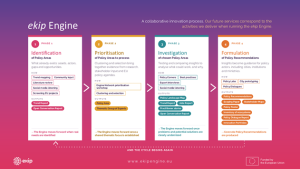
ekip’s stakeholder engagement methodologies such as Policy Labs, the OPSI model, the ecosystem inventory and city prototyping aligned with the EIT CC KIC’s activities across its 101 partners and other stakeholders. In particular, ekip’s creative approaches offered ways for CCI actors to contribute meaningfully to discussions and engage stakeholders in future regional partner meetings.
In October 2025, EIT CC NW co-organised a Community Review Policy Lab with the Netherlands Institute for Sound and Vision on the role of cultural heritage institutions within open innovation ecosystems, an area of shared interest for ekip and the EIT CC KIC. The event took place alongside an EIT CC NW network partner event in Amsterdam, creating an opportunity for ekip to connect with the wider EIT cultural and creative industries network. Of the 26 people who attended the Community Review Policy Lab, 16 were also associated with the EIT network, including one of the speakers.
Extending networks and opening new areas for collaboration
The collaboration enabled ekip to share its policy insights beyond its immediate network, exchange knowledge with other research networks and CCI actors, and learn from perspectives outside the ekip community.
Conversations during the Community Review also sparked interest from EIT CC NW in the topic of traceability and trust in the CCIs. EIT CC NW is now interested in bringing together stakeholders who design, enforce or need to follow these systems across the cultural and creative industries, such as digital product passports (DPP), which hold information about a product’s origin and lifecycle, metadata standards and C2PA, a technical standard developed by the Coalition for Content Provenance and Authenticity that records where a piece of digital content came from and how it has been edited.
Looking ahead: Building a network of networks
Looking towards the future, EIT CC NW expressed an interest in actively involving and learning from partners who had also been part of the ekip project. As the EIT CC NW representative put it, “Think about it like a network of networks.” The aim is to better spotlight and amplify existing projects and initiatives rather than starting from scratch. Working with partners from programmes such as ekip can help identify opportunities for support, connect existing networks and build on knowledge and approaches that are already available.
Conclusion
The article set out to answer how knowledge creates opportunities for initiatives to connect, so it’s high time that we approached an answer: it does so positively, rather than starting from isolation. The knowledge European initiatives generate is most valuable when it keeps moving. When Creative FLIP and ekip compared their findings, both came away with a sharper understanding of how creative work is financed. When ekip’s methods travelled to the North-West Regional Hub, they found a new community ready to put them to use. Europe already has the pieces. Its next step is to connect them, one exchange at a time, until separate initiatives grow into a network of networks.
About this article
This article is based on research carried out by Dr Anna Kallen Talley (Institute for Design Informatics, University of Edinburgh) for ekip’s Deliverable 6.2, which will be published on CORDIS with the project’s other deliverables. The case studies draw on interviews with representatives of Creative FLIP and the EIT Culture & Creativity North-West Regional Hub, who reviewed and contributed to the original research over several weeks and gave permission for the material to be published here. The EIT Culture & Creativity case study reflects the experience of the North-West Regional Hub only, and not that of other hubs or departments within EIT Culture & Creativity. Illustrations have been developed by ekip.
1 https://creativeflip.creativehubs.net/assets/upload/FLIP_Final_Study_final_.pdf
2 https://knowledge-bank.ekipengine.eu/resource/green-storytelling-through-art-culture-and-heritage/
5 https://www.europarl.europa.eu/thinktank/en/document/IPOL_STU(2024)752453
Latest ekip News and Updates
November 10, 2026
By Katerina Kalimera (MSCOMM), based on research by Dr Anna Kallen Talley (Institute for Design Informatics, University of Edinburgh)
From Shared Knowledge to Collective Impact: Connecting Europe’s Creative Ecosystems
How do we make sure that the knowledge generated across Europe creates opportunities for different initiatives to connect, collaborate and co-create?...
November 10, 2026
By Paul Hekkert (Opinion column)
Redesigning Europe: The Dutch lessons
Europe’s cultural and creative industries have the skills to help tackle society’s biggest challenges....
October 28, 2026
By Bodil Malmström
“Culture can provide a kind of glue between technology and society”
Digital commons thrive on sharing knowledge, culture and building communities, rather than innovation for its own sake. ...
October 18, 2026
By Lena Holmberg
AI scraping hits heritage
Cultural heritage institutions are struggling with a surge of commercial AI scraping....
