


 News,Outreach,Policy Spotlights
Bridging Policy, Practice, and Innovation: The Future of Immersive Technologies in the CCIs
News,Outreach,Policy Spotlights
Bridging Policy, Practice, and Innovation: The Future of Immersive Technologies in the CCIs
Bridging Policy, Practice, and Innovation: The Future of Immersive Technologies in the CCIs
By Caitlin McDonald, Morgan Currie and Emma Pirie

Open Innovation Factories as a catalyst for immersive technologies
The Cultural and Creative Industries (CCIs) are at the forefront of technological innovation, often turning speculative ideas into transformative tools. To harness this potential, ekip’s Open Innovation Factories foster industry awareness of new methods for collaboration, ideation, and development developed through ekip’s original research and policy initiatives.
By bringing together creatives, technologists, and policymakers, Open Innovation Factories also empower participants to feed into ekip’s work and help shape vibrant, inclusive futures for the CCIs across Europe and beyond.
Our October 2024 Innovation Factory, held in Edinburgh and online, showcased the power of this approach, combining two panels with a hands-on workshop on immersive technologies.
The policy and impact panel – addressing gaps and opportunities
Chaired by Dr Suzanne Black of the CoSTAR Foresight Lab, this panel set the stage for how strategic policymaking can enhance immersive technology development.
Liz Rosenthal, founder of Power to the Pixel, and Dr Victoria Williams, Policy and Partnerships Manager at CoSTAR Foresight Lab, discussed the challenges facing small creative businesses in navigating funding and policy landscapes.
Rosenthal highlighted the lack of dedicated funding for immersive technologies in the UK, contrasting it with more robust support systems in France and Canada. She called for targeted funding streams for immersive and interactive content, which could unlock private investment and international collaboration.
Williams emphasized the need for policymakers to engage directly with immersive technologies to better understand their potential. She suggested open-door models, like Digital Catapult’s 5G lab, where stakeholders can experience immersive innovations firsthand.
Both panellists advocated for tax incentives and skills training initiatives to lower barriers for creators, especially those from underrepresented groups.
The panel concluded with a call for greater collaboration between policymakers and practitioners to craft flexible, forward-thinking strategies. ekip’s Policy Lab series is one example of how ekip is working to create bridges between policymakers and CCI practitioners to accelerate impact and innovation for the CCIs.
The creative practice panel – pioneers in immersive technology

This panel presented insights from creative practitioners Ana Betancourt of Black Goblin and Theodore Koterwas, an artist innovating with AI and tactile technology.
The session was chaired by Caroline Parkinson, Director of Creative Industries Engagement at the University of Edinburgh’s Edinburgh Futures Institute.
Betancourt introduced Thol, a sound design suite that simplifies the creation of high-quality sound effects for film and game production. By using AI to handle monotonous tasks, Thol allows sound designers to focus on their creative vision, reducing costs and complexity.
Koterwas explored the physical interactions between humans and AI in works like Tactile Intelligence, which uses motion-tracking and haptics to create immersive, embodied experiences. By positioning technology as a collaborator rather than a tool, his work redefines the relationship between creators and machines.
Both speakers emphasized the importance of policymaking to support innovation, from R&D funding to clearer intellectual property protections for small creators.
Forecasting futures through open innovation
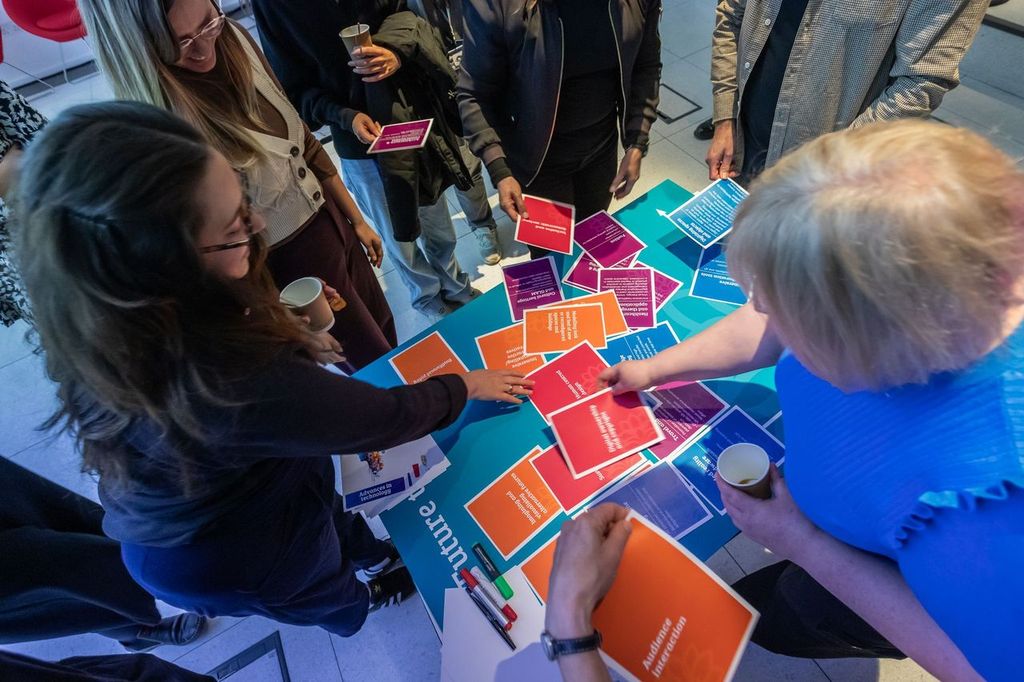
Following the two panels, participants engaged in an interactive workshop designed to explore how open innovation can shape future technology scenarios for immersive technologies.
Following a brief icebreaker, the workshop followed a structured process.
Future casting:
Using trend cards prepared through ekip’s previous horizon scanning and policy priority clustering, participants identified key drivers of immersive technology development. Groups debated societal, industrial, and policy priorities. In-person attendees highlighted healthcare and therapy applications as a transformative focus, while online participants emphasized immersive storytelling, cultural heritage, and sustainability.
Hopes and fears:
Building on the prioritization exercise, participants created scenarios for their chosen themes. For healthcare applications, hopes included improved patient doctor communication and greater accessibility to treatments, while fears revolved around data misuse and deepening inequalities.
Impact analysis:
Participants explored how open innovation could shape these scenarios. They envisioned futures supported by matched funding, networking hubs, and inclusive policies as well as dystopian alternatives marked by surveillance and systemic inequities.
Concluding with a brief wrap-up, participants consolidated their insights, identifying pressing questions such as how to ensure technology creators represent user needs and how to break barriers between policy, academia, and industry.
Takeaways for the cultural and creative industries
The Open Innovation Factory approach demonstrates how speculative scenarios can guide actionable insights for CCIs.
By prioritizing collaboration, inclusivity, and foresight, these workshops create pathways for creatives to influence policy and industry. As immersive technologies evolve, the CCIs have an unparalleled opportunity to shape their trajectory, ensuring these tools enrich rather than exploit.
Whether creating soundscapes with Thol or designing AI-powered embodied experiences, the future of CCIs depends on our ability to imagine and build futures that reflect our collective hopes and address our shared fears.
Open Innovation Factories offer a powerful model for helping CCI practitioners think through and apply ekip’s emergent research and policy priorities, supporting the CCIs in making these futures a reality.
A full video of the event and discussions can be viewed here:
Latest ekip News and Updates

October 18, 2026
By Lena Holmberg
AI scraping hits heritage
Cultural heritage institutions are struggling with a surge of commercial AI scraping....
October 1, 2026
Europe has the pieces. In Eindhoven, ekip shows how to connect them.
On 23 October, during Dutch Design Week, three years of European work on the cultural and creative industries changes hands ...

September 17, 2026
By Michalis Stangos
Four things Europe needs to get right on the creative industries, and one that is still missing
Europe is losing the technology race, but it still leads on creativity. ...
September 3, 2026
By Lena Holmberg, Lund University
AI and CCI: Shaping Europe’s Next Step
Across Europe, cultural and creative actors are asking a similar question: how can artificial intelligence be shaped in ways that strengthen creativity, cultural diversity and democratic innovation, r...
