


Designing Materials for a Regenerative Future
By Bodil Malmström
From fungal textiles to living artefacts, researchers and designers are turning to deep tech to rethink what materials can do—and who they are for.
Design is no longer just shaping form, it is increasingly about shaping life itself. In labs where biology meets engineering, a new class of biomaterials is emerging, powered by deep tech and driven by a regenerative agenda.
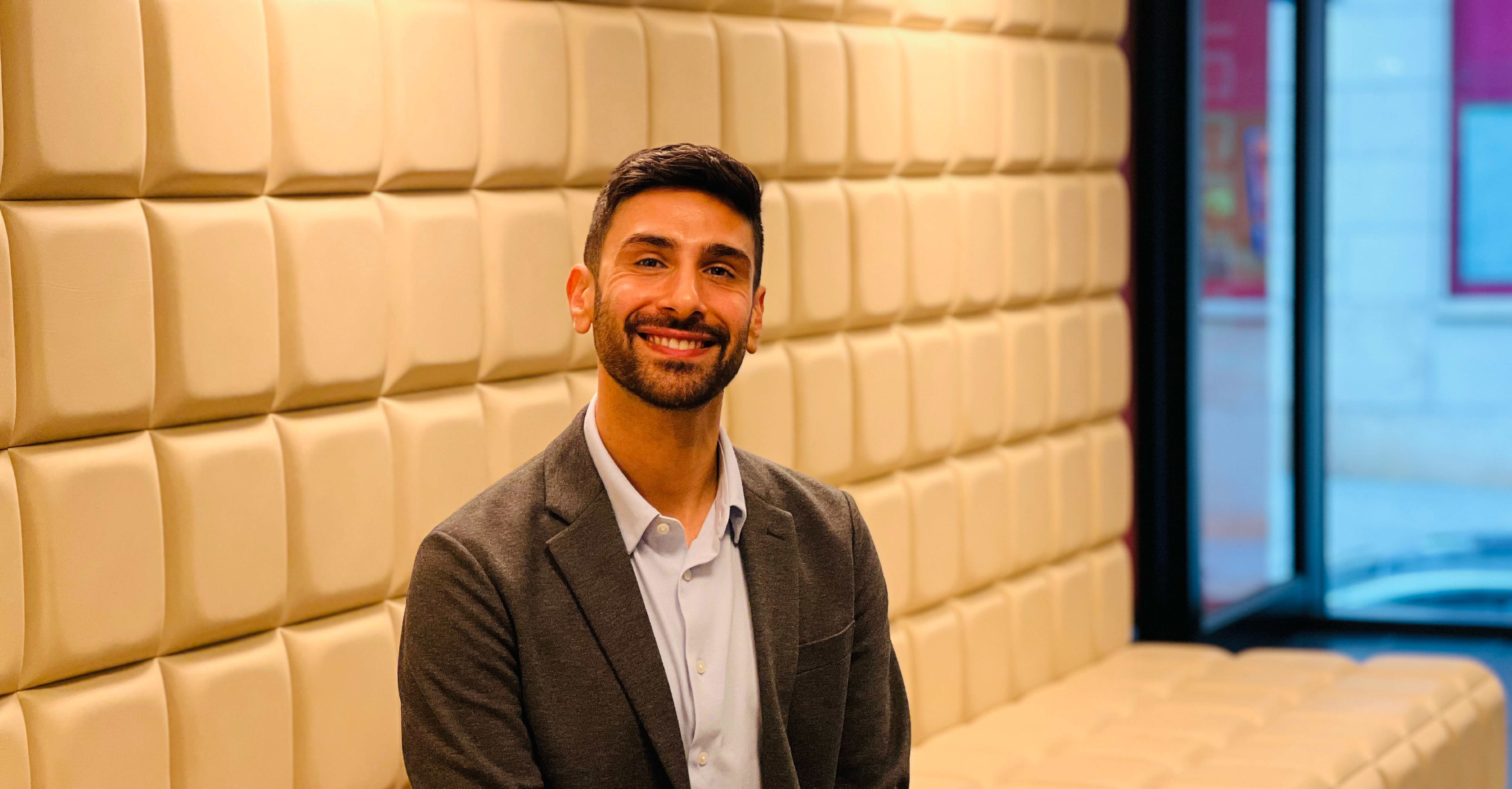
“Designing biomaterials for a regenerative future is not about minimising harm,” says Stefano Parisi, Assistant Professor at TU Delft, Industrial Design Engineering, working with biofabricated and living systems, and active in the fields of biodesign and material-driven design. Stefano Parisi took part in ekip´s Policy Lab in Brussels on Deep Tech.
“It’s about improving ecosystems—creating materials that actively contribute to biodiversity and environmental health, and ultimately human wellbeing.”
At the core of this shift is a redefinition of materials: from passive resources to dynamic, sometimes living, systems.
From sustainability to regeneration
Where sustainability focuses on reduction, regeneration demands contribution.
Stefano Parisi refers to a set of guiding pillars developed within the Center of Design Research for Regenerative Material Ecologies (DREAM), which he co-founded together with Elvin Karana and Holly McQuillan in 2024, and which he uses to inform and assess regenerative design approaches. The first is circularity, but expanded.
“It’s not just about closing loops,” he explains. “It’s about nurturing the environment and giving something back that enhances it.”
The second is biodiversity. Materials are evaluated by how they interact with ecosystems.
A biomaterial should do more than safely return to nature — it should invite life in. Through approaches like bioreceptive design, products can host moss, microbes or fungi even during use, becoming small ecosystems rather than static objects.
Success, then, is measured not only in function, but in how much life a material makes possible.
Equally important is ecological literacy.
“Materials can teach,” Stefano Parisi says. “They can reveal metabolic processes, ecological relationships and help users understand they are part of a larger system.”
Ultimately, the goal is cultural.
“It’s about shifting worldviews,” he adds. “From extraction to participation.”
Deep tech meets living matter
Much of this work is made possible by advances in deep tech. Particularly biotechnology, synthetic biology, and material engineering.
Stefano Parisi has been following mycelium, the filamentous vegetative network of fungi, for over a decade.
“I started working with it ten years ago, during my master’s graduation project,” he says. “And I never stopped — it’s an organism with a lot of surprises.”
What keeps him hooked is its versatility. Mycelium can become many things: a composite for acoustic insulation in the building sector, a packaging material or a soft textile.
In his latest project, that potential takes the form of a fungal textile — grown rather than manufactured. In one process, the material is cultivated directly in the lab from liquid culture, forming a continuous sheet. In another, it is made by blending fungal fruiting bodies into a pulp.
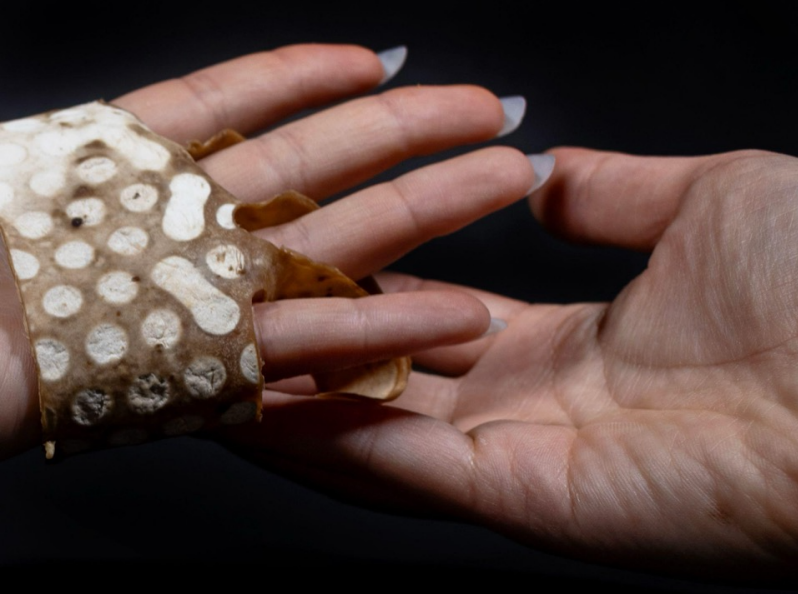
The fungal textile project. Photo: Jierui Fang
But the real shift lies in how the material is shaped.
“We can design patterns with locally varied thickness and padded qualities directly during the growth, drying, and making process,” Stefano Parisi says. “So you don’t need to add layers or assembly afterwards — the customization is already embedded.”
It is a glimpse of a different kind of production. Not assembly, but cultivation. Not control, but collaboration — with an organism that, as Stefano Parisi puts it, “still has many surprises to reveal.”
“Biotech is deep tech,” he adds. “It requires collaboration across biology, engineering, and design and a different way of thinking about materials altogether.”
This convergence of disciplines is increasingly visible within the international biodesign community. Later this year, researchers and design practitioners will gather at TU Delft for the Biodesign Conference 26–28 August 2026, co-chaired by Stefano Parisi, to explore advances in biodesign, biofabrication, and living materials.
One of the more speculative, yet rapidly developing, areas is responsive biomaterials, systems that react to physiological or environmental signals.
Projects are already exploring materials that exhibit temporal behaviours, shifting colour, shape, or structure in response to stress, temperature, or recovery states. Stefano Parisi points to bio-integrated systems that could support wellbeing, healing or dynamically adapt to the body and user experience.
The implication is profound: materials that don’t just serve the body, but communicate with it.
Commercialisation, however, remains distant or uneven across the field. Some of these biomaterials are already finding applications, while others are still at an early stage of development.
“We’re still early but involving society in the process—understanding what people experience, accept or desire—can help accelerate adoption.”
Creatives bring clarity
Yet these transformations are often slow, subtle, or invisible, posing a challenge for public understanding.
This is where design, fashion, performing arts, and other cultural and creative industries enter.
“Living materials change over time—grow, degrade, self-heal,” Stefano Parisi says. “Creative practices can help make these processes visible and understandable.”
By presenting and staging these processes, art and design translate scientific phenomena into sensory experience. It brings unfamiliar materials into familiar cultural contexts creating emotional and narrative connections that lab prototypes alone cannot achieve.
Redesigning the design process
The rise of biomaterials is also reshaping disciplinary roles.
In traditional workflows, designers selected from materials developed elsewhere. Now, they are directly involved in material creation.
“Material-driven design reverses the process,” Stefano Parisi explains. “Designers contribute to how materials are developed and not just how they’re used.”
This shift dissolves hierarchies between design, biology, and engineering. It also brings users into the process earlier through perception studies, behavioural testing, and co-creation. This approach reflects principles of material-driven design, where material development and human experience evolve together rather than sequentially.
A collective role—and a systemic gap
The biomaterials researcher, Stefano Parisi suggests, must be hybrid by necessity: part designer, part engineer, part facilitator, part ethical steward.
But while labs advance, infrastructure lags.
“The biggest barrier is public understanding,” he says. ”Questions of safety, trust, and reliability—especially when working with living organisms—remain unresolved. We need to integrate these concerns from the beginning and better understand how people experience, perceive and interact with these materials through dedicated user studies.”
Wearables at the frontier
Wearable and textile systems may be where biomaterials become most tangible and most transformative.
“These materials carry values,” says Stefano Parisi. “Care, longevity, connection to ecosystems.”
Worn close to the body, they create an intimate interface between human and environment. Unlike more distant applications, garments are embedded in identity, emotion, wellbeing, and everyday practices.
“They could become a link,” he suggests. “Helping us understand nature because they are part of us, and we are part of them.”
In that entanglement lies the promise of regenerative design: not just new materials, but a new relationship with nature.
Latest ekip News and Updates

October 1, 2026
Europe has the pieces. In Eindhoven, ekip shows how to connect them.
On 23 October, during Dutch Design Week, three years of European work on the cultural and creative industries changes hands ...
September 17, 2026
By Michalis Stangos
Four things Europe needs to get right on the creative industries, and one that is still missing
Europe is losing the technology race, but it still leads on creativity. China used to recruit European engineers. ...
September 3, 2026
By Lena Holmberg, Lund University
AI and CCI: Shaping Europe’s Next Step
Across Europe, cultural and creative actors are asking a similar question: how can artificial intelligence be shaped in ways that strengthen creativity, cultural diversity and democratic innovation, r...
July 16, 2026
By Katerina Kalimera
Translators, mediators, connectors: the missing infrastructure of innovation
At the ekip Academy in Tallinn, the South of Scotland team described themselves as the “glue” forming sectors and enabling collaboration, a basic idea that stayed with attendees throughout the event....
