


 News,Tools of Change
Graphic recording for innovation: A strategic communications tool
Graphic recording for innovation: A strategic communications tool
By Katerina Kalimera
Most of my working life happens in fast-paced rooms where important decisions are made. The clever people, the fired-up discussions and the tangle of thoughts are what make my work interesting, to say the least. In this kind of room, a communicator’s job is to keep pace, make sense of the dense information (someone would say chaos) and channel the energy into something to build on.
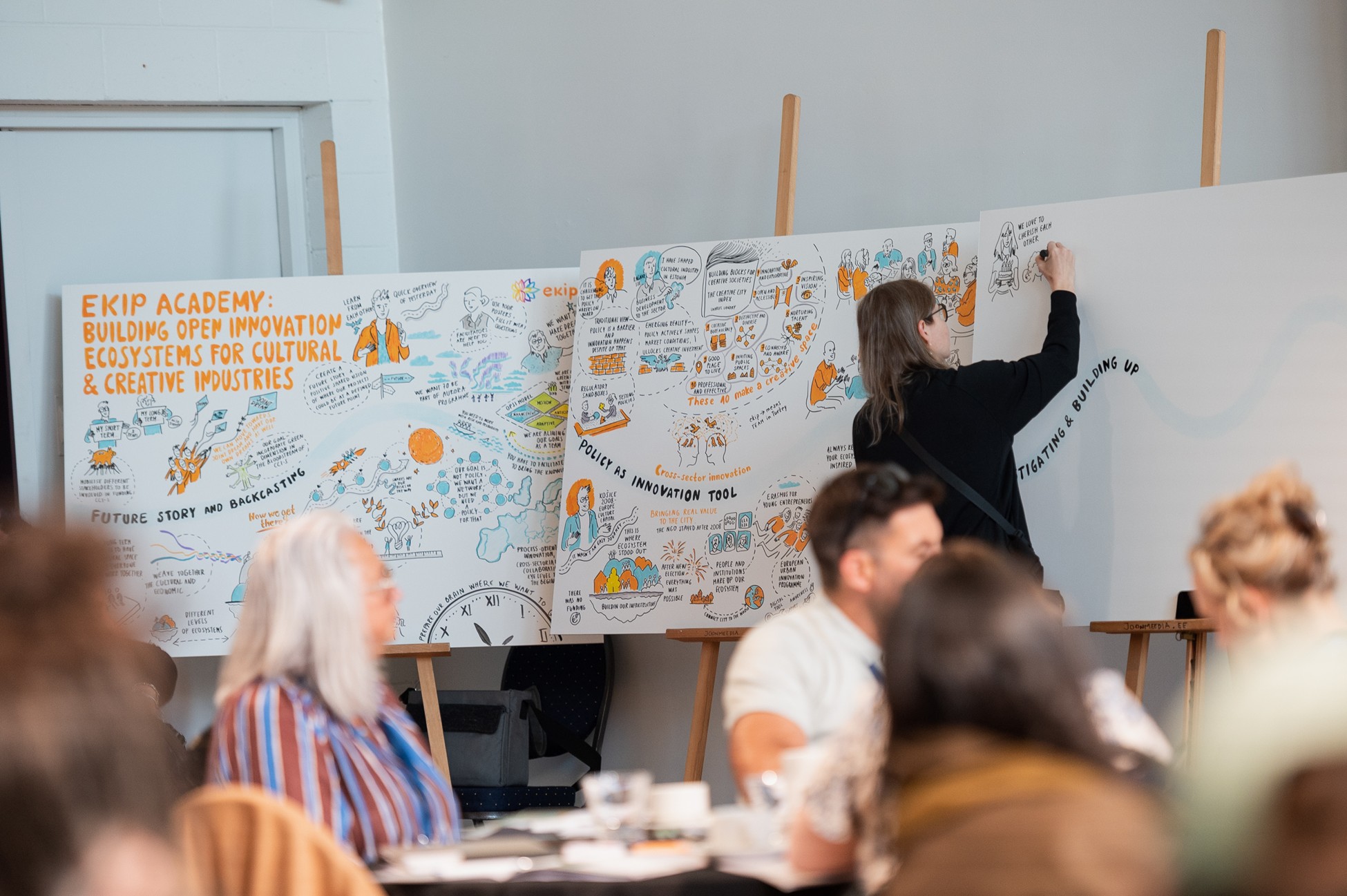
Back in June, at the ekip Academy in Tallinn, I watched someone do that very same job but in a very different medium. Amidst the noise of a room full of ideas, Siiri drew, silently, in the corner. As thoughts and ideas started coming together, Siiri kept drawing on her canvas that later became a five-meter drawing of the room’s thinking process.
That day the room learned a new term: graphic recording. When I went back to it this autumn, with Siiri’s reflections in hand and a few months’ distance from the week itself, I realised there was something more to say.
A room with fourteen languages
Siiri Taimla-Rannala had been a graphic recorder for 17 years, and she had never stepped in a room twice. “You dive into an unknown area,” she told me afterwards, “and you had better be prepared to be surprised, because you never really know what is going to happen in the room.”
The ekip Academy was not an exception. This time, what surprised Siiri was the discussions held in fourteen languages. There were around fourteen groups from different nationalities, so, to keep up, we had organised a small team of “whisperers”, who moved between the tables and carried the main points of each conversation back to Siiri. In all her years of graphic recording, she said, it was the first time she had faced a challenge quite like it.
The room that week looked like a sample of Europe’s innovation ecosystems: many conversations happening at once, in different languages. Each group held part of the picture, but the ideas remained within their own circles. Graphic recording created a shared space where they could sit alongside one another, making connections visible across the room.
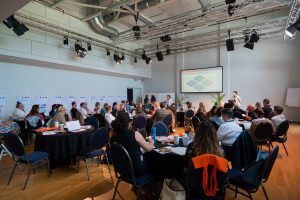
ekip Academy 2026
What graphic recording actually does
Graphic recording can be easily mistaken for note-taking. Although they are not quite the same.
Notes are static; they record what was said at a particular point in time, and the argument is over and done once the ink has dried. Graphic recording visualises the room as the conversation unfolds, translating ideas and exchanges into a shared visual reference. From a communications perspective, that reference lets participants see how ideas relate, point to specific parts, question them and build on them together. Cognitive research describes external representations as shareable objects of thought that can help coordinate thinking (Kirsh, 2010). In a study of co-creative meetings, participants reported that pointing to the graphics helped them form a common understanding (Ishii, Nakatani and Watanabe, 2022). Once decisions are made, the image remains as a record of both what was discussed and how the group’s thinking developed.
Siiri describes the finished picture as “a meeting point for ideas, where all participants can come at any time to reconnect with the thoughts that have resonated in the room.” After the event, she says, it becomes “a great tool for memory extension”. People get to re-experience what was said and the atmosphere of thinking together.
Graphic recording is communication: it slows a conversation so shared meaning can stay visible while it forms, and it testifies to the thinking, exchanges, and ideas that brought people to a shared understanding. To me, this is communication in its purest form: making ideas and perspectives legible in relation to one another without flattening their complexity. Graphic recording does this in real time. It gives a fast-moving conversation a shared visual form, making the thinking and exchanges behind a shared understanding visible, not just the conclusion.
Why this matters for innovation
This becomes most useful in cross-disciplinary innovation. Technologists, policymakers, and artists come in the same room with the same intent, then have long conversations only to leave with different understandings of what they agreed to. And this is where work stalls in my experience. Graphic recording makes those different perspectives visible. It brings complex ideas, conversations, and connections together in one shared visual space, giving everyone something concrete to look at, question, and build on, and that’s often where progress begins.
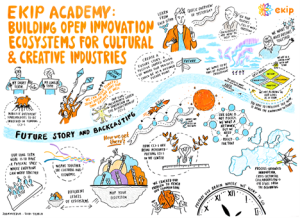
Graphic recording by Siiri Taimla-Rannala
What the wall made visible
Ideas appeared as the drawing grew. Teams kept returning to the OPSI model, a framework from the OECD’s Observatory of Public Sector Innovation, and to the question of which of its colour zones they currently sat in. They talked about how to reach a common goal within their own team. Above all, they talked about ecosystems, which Siiri thinks was probably the most used word in the room.
Then there was a river. At one point a participant said, quite simply, “It’s a long-term approach,” and Siiri drew it as a winding river that runs through the entire picture. It doesn’t force the other images into a single direction, but it holds them together and reminds anyone looking at it that this kind of work takes time. “I really like the metaphor,” she told me, “And the image I drew to represent it.”
When I asked her which image best captured the spirit of the Academy, she chose the swarm of bees, drawn beside a line from one of the discussions: “It’s rather a swarm of smaller actors working together, not unicorns. It’s our strength.” It is as good a summary of what ekip has been arguing for as any I have read, and it came from the participants themselves.
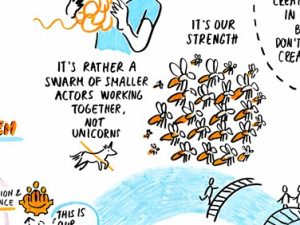
Graphic recording by Siiri Taimla-Rannala
Creativity as connective tissue
This is also the premise behind ekip. Innovation across sectors depends on expertise, but it equally depends on translation. Translation means moving between disciplines and making one group’s thinking legible to another. Creative practitioners are often the ones doing that work, even when it isn’t recognised as innovation. At the Academy, this argument was drawn on the wall, on its own.
Siiri sees the appetite for it wherever she works. “I think people yearn for creativity, whether they work in policy or some other sector,” she said. “It might actually be nice to stay inside the box, provided you can get out of it from time to time and then reshape your box with new insights and inspiration.”
The room, still thinking
While I was finishing this piece, a message arrived from Siiri. Her work had just won a bronze at the Estonian Design Awards in Tallinn the first-time graphic recording has been recognised at the awards. She sounded delighted for the field, as for herself, and I make my own reason out of this.
Graphic recording has long been treated as something that happens at the edge of the room, useful and lovely to look at, but not quite the main event. Recognition from a national design community suggests that the landscape is changing, and that the work of making meaning visible is starting to be valued as a discipline in its own right.
At the end of the Academy, the wall still held the river, the swarm, the ecosystems and all those overlapping languages, a single surface carrying many conversations at once. If you stood in front of it long enough, you could see the room, still thinking.
Congratulations, Siiri.
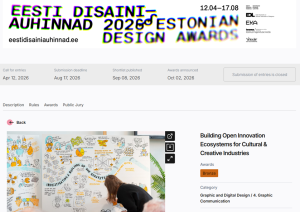
Screenshot from defolio.com – “Estonian Design Awards”, ([1]), accessed 11/19/2026.
Latest ekip News and Updates
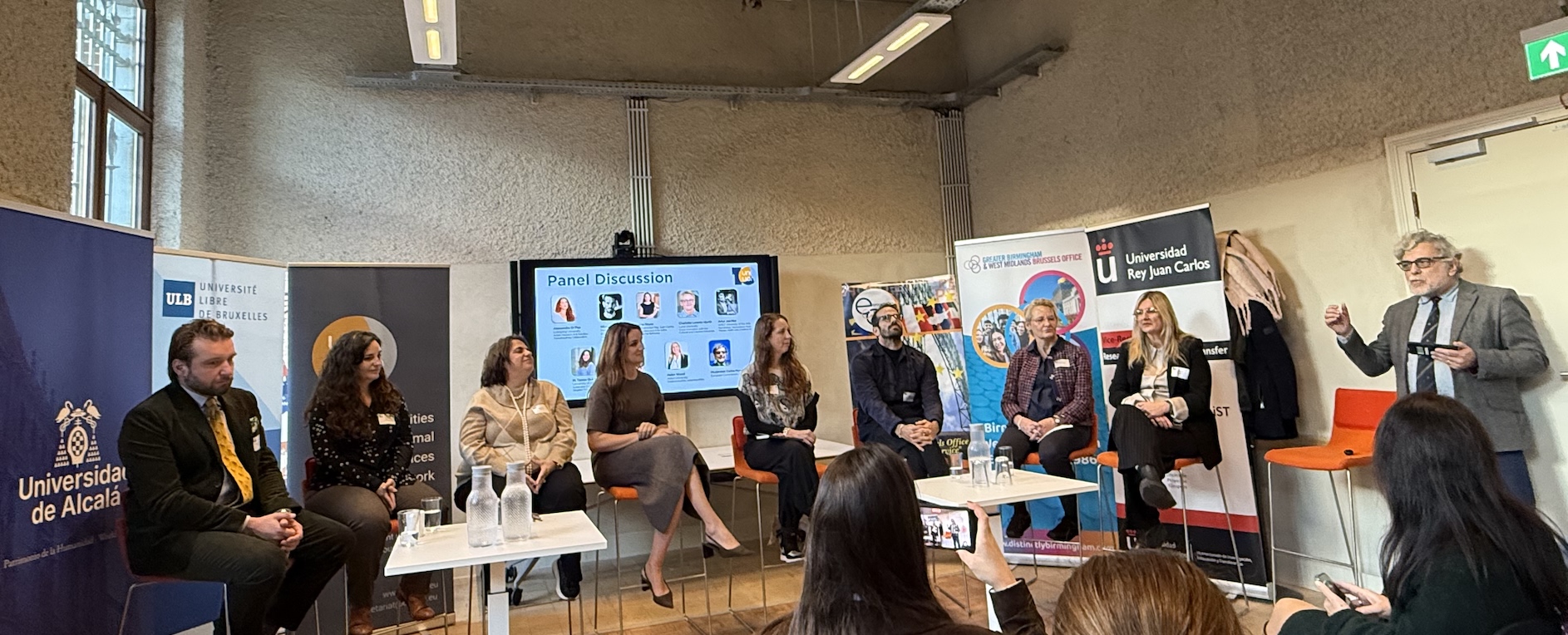
November 26, 2026
By Bodil Malmström
Universities as engines of place-based innovation
A stronger friendship between universities and the Cultural and Creative Industries could help unlock Europe's innovation potential. ...
November 24, 2026
By Katerina Kalimera
Graphic recording for innovation: A strategic communications tool
Most of my working life happens in fast-paced rooms where important decisions are made. ...
November 16, 2026
By Mats Benner | Opinion Column
Can universities be creatives’ best friend?
One of the key lessons of ekip is that the CCIs benefit from linkages with universities. ...
November 10, 2026
By Katerina Kalimera, based on research by Dr Anna Kallen Talley
From Shared Knowledge to Collective Impact: Connecting Europe’s Creative Ecosystems
How do we make sure that the knowledge generated across Europe creates opportunities for different initiatives to connect, collaborate and co-create?...
