


 News,Policy Spotlights
Where Art Meets Algorithms: New Frontiers in Deep Tech and the Creative Industries
News,Policy Spotlights
Where Art Meets Algorithms: New Frontiers in Deep Tech and the Creative Industries
Where Art Meets Algorithms: New Frontiers in Deep Tech and the Creative Industries
By Bodil Malmström
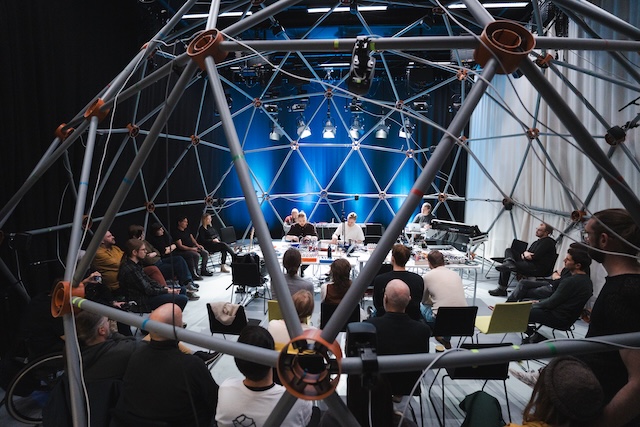
As Europe accelerates its push into deep tech, Finland is emerging as a driving force in connecting it with the Cultural and Creative Industries. Across AI, robotics and immersive technologies, new models of collaboration are taking shape—where artists, researchers and industry work together to turn technological innovation into shared cultural and economic value.
In a former industrial corridor in northern Europe, something unusual has been taking shape. Not quite a conference, not quite a festival, Avara has become a magnet for artists, engineers, funders and researchers—many of whom, until recently, moved in entirely separate worlds.
“When we started, there wasn’t really an art–tech scene here,” says Julia Heikkinen, with a background as a producer and one of the driving forces behind Avara. “We realised we needed to create a platform where a community could even begin to exist.”
Four years on, the results are difficult to ignore: sold-out events, returning participants, and an ecosystem beginning to cohere. What has emerged is not just a gathering, but a functioning node in Europe’s deep tech–creative industries (CCI) landscape.
A platform before a market
Avara’s role is deceptively simple: bring people together. But in the context of deep tech, that is no small task.
“We call it a hybrid between a conference and a festival,” Julia Heikkinen explains. “You have keynotes and panels, but also workshops, demos, testing sessions—places where artists and tech providers actually work together.”
This participatory structure is critical. Deep tech—AI, robotics, immersive systems—remains expensive, complex, and often inaccessible. Without shared spaces, collaboration rarely happens.
“It has to be on site,” she says. “Online doesn’t create the same connection. You need those moments where people test, fail, and discover something together.”
The economics of collaboration
Before any structure existed, there was already a clear vision: that art and technology would become a defining pillar of Oulu’s cultural strategy. What was missing, however, was a coordinating body to bring artists, researchers, and companies into the same space.
“I established this unit called the Arts Innovation Research Programme with my colleague years ago,” says Julia Heikken, reflecting on how it all began, “at the time when Oulu was bidding for the European Capital of Culture title, which we now have right on now.”
What started as a small, project-based research initiative—initially run by just two people with internal university funding—quickly turned into a European-scale operation. The team made an ambitious promise: if supported, they would bring back one million euros through EU-funded projects.
“We actually made a promise to our university that if they would give us the internal funding, we would bring back 1 million euros,” Julia Heikkinen says. “But we did that already during one year, so we’ve been quite successful.”
Today, the unit operates inside a research and development structure, blending academic work with applied experimentation. The model is deliberately hybrid: part roadmap, part funding-driven agility.
That structure is not abstract—it is physically grounded in labs and experimental environments that change how collaboration happens. Sound domes for spatial audio, AR production studios, and printed electronics labs are not just infrastructure, but catalysts.
“When you have facilities it somehow changes the game,” she says. “There is equipment available that really opens the door and brings the people to you.”
Unexpected meetings
One such encounter came through the EU-funded STARS programme. An artist in residency, working with robotics and creative coding, was placed in a printed electronics lab alongside engineers specializing in sensor technologies. Neither side initially knew what to expect.
What followed was not a planned outcome, but an emergent one. The collaboration led to the integration of sensor technologies into new materials—applications that had not previously been considered by either side. In parallel, it opened up a new market direction for the technical team, while giving the artist an entirely new experimental language.
“That led them to a new market field in practice,” she says. “And the artist was also very happy about the new experimentation.”
For Julia Heikkinen, this is the real value of the ecosystem: not isolated innovation, but structured serendipity. The labs and programs provide the conditions for unexpected encounters. Where deep tech and creative practice collide in ways that neither side can fully predict.
“If you zoom out,” she reflects, “you can see all this potential in these unexpected meetings that the venues or the labs provide. They provide the scene, but the unexpected meetings.”
Yet she is also clear-eyed about the limitations. These outcomes are compelling to those who experience them directly, but harder to communicate beyond the room. “Those who have witnessed it or experienced it, they are fully convinced,” she says. “But at the same time it needs a lot of lobbying.”
In Oulu’s evolving art-and-tech landscape, the challenge is no longer proving that collaboration works. It is making sure the systems—funding, policy, and institutional frameworks—can keep up with what is already happening in the lab.
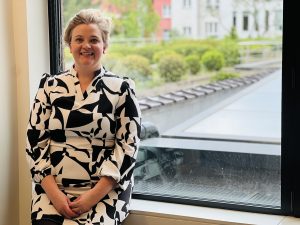
Julia Heikkinen took part in ekip´s Policy Lab in Brussels focusing on the role of cultural and creative industries in Europe’s deep-tech landscape.
Who shapes whom?
This raises a persistent question: are artists driving technology, or merely adapting to it?
“They can absolutely change it,” Julia Heikkinen says. Increasingly, tech companies are inviting creatives into the process, not at the end, but earlier. “They want to see where creative thinking takes their technology.”
In some cases, companies even relinquish control. New platforms are released to artists for free experimentation, with developers observing what emerges.
“There’s a shift,” she adds. “Letting go can actually create more value.”
The overlooked frontier: health and emotion
Among the most underexplored intersections, Julia Heikkinen points to health tech.
“It’s huge, and it’s only growing,” she says. ”But beyond clinical efficiency lies something less tangible: human experience.”
She recalls a Canadian project where artists worked with palliative care patients, reconstructing meaningful places in virtual reality.
“They brought those environments back to the patients,” she says. “And many passed away shortly after. It was like coming home.”
It is a stark example of how deep tech, often perceived as cold or abstract, can become deeply emotional when filtered through artistic practice.
Trust, risk and creative freedom
Despite growing interest, a gap persists: artists and technologists still struggle to find each other.
“We live in bubbles,” Julia Heikkinen says. “Why would these worlds meet organically? They wouldn’t.”
This is where intermediaries—curators, producers, facilitators—become essential. And yet, they remain scarce.
“When budgets are cut, intermediaries are often the first to go,” she notes. “But they are exactly what makes collaboration possible.”
Bringing these worlds together also means negotiating risk.
For artists, the concern is often autonomy.
“They don’t want to compromise their freedom,” Julia Heikkinen says. “And they shouldn’t.”
For technologists and institutions, the risks are more operational: time, resources and uncertainty. In one theatre project, introducing new technologies required entire production teams to adapt, stretching schedules and capacities.
“Someone always carries the risk,” she says. “So, it has to be acknowledged.”
Trust, in this context, is less about contracts than experience.
“Once people have done it once, they become believers,” she adds. “But getting to that first time, that’s the challenge.”
Towards a shared ecosystem
What would a mature, fully functioning deep tech–CCI ecosystem look like in ten years?
“In ten years, they grow together. Sharing the same environment, depending on one another, and ultimately nurturing each other.”
It is a vision of deep tech not as a separate domain, but as embedded within cultural production, shaped as much by artists as by engineers.
For now, that future remains uneven. Interest in the creative industries, Julia Heikkinen suggests, has waned somewhat in recent years. But she is convinced it will return.
“It’s a resource we’re not fully using yet—and in a world increasingly defined by technology, that unused resource, human creativity, may prove to be the most valuable of all.”
Latest ekip News and Updates
October 18, 2026
By Lena Holmberg
AI scraping hits heritage
Cultural heritage institutions are struggling with a surge of commercial AI scraping....

October 1, 2026
Europe has the pieces. In Eindhoven, ekip shows how to connect them.
On 23 October, during Dutch Design Week, three years of European work on the cultural and creative industries changes hands ...

September 17, 2026
By Michalis Stangos
Four things Europe needs to get right on the creative industries, and one that is still missing
Europe is losing the technology race, but it still leads on creativity. ...
September 3, 2026
By Lena Holmberg, Lund University
AI and CCI: Shaping Europe’s Next Step
Across Europe, cultural and creative actors are asking a similar question: how can artificial intelligence be shaped in ways that strengthen creativity, cultural diversity and democratic innovation, r...
