


 From the Lab,News
Translators, mediators, connectors: the missing infrastructure of innovation
From the Lab,News
Translators, mediators, connectors: the missing infrastructure of innovation
Translators, mediators, connectors: the missing infrastructure of innovation
By Katerina Kalimera
When the teams at the ekip Academy in Tallinn introduced themselves, most did what teams do: they named their region, their sector, their strategy. The team from the South of Scotland did something different. They described themselves by function. Translators, mediators and connectors, they said – people who operate “at the junctions between sectors and industries”, linking artists and cultural organisations to the resources and networks that help them innovate. Then they reached for a more specific, better word. They act, they said, like glue: a fluid that finds and fills the gaps, sticky enough to hold siloed industries together long enough for something to happen between them.
It was the most precise self-description offered in four days, and I kept returning to it – because once you have the word, you start seeing the thing everywhere.
The same gap, in seven vocabularies
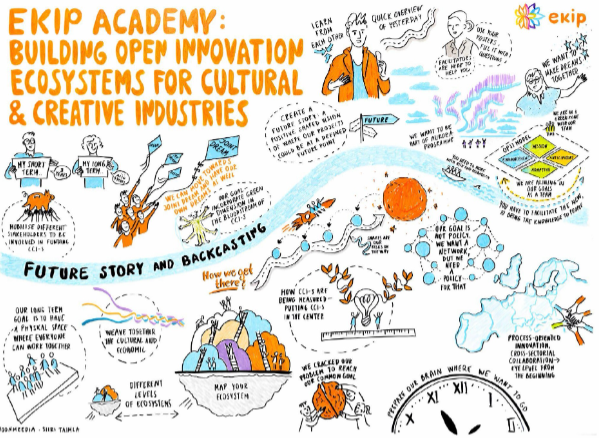
On the second day of the Academy, the facilitators walked through ekip’s building blocks – the structural conditions an open innovation ecosystem needs. Each block was presented by a different person, from a different discipline, in a different register, and underneath nearly every one of them sat the same problem.
On sustainable competitiveness, Charlotte Lorentz Hjorth argued that the cultural and creative industries hold “bits and pieces” of innovation activity but lack connected ecosystems and that what’s needed is translation: getting innovation concepts across to cultural organisations in language they can actually use. On research and innovation, Nicola Osborne named a gap in the very vocabulary of innovation – funding flows readily towards high-level research and technology, while the contribution of citizens and creatives sits outside the terms policy recognises. On infrastructure, Marko described the absence of a common language for cross-innovation, and pointed to the Basque Country, where the sector itself has been activated as the intermediary – a platform where players connect and share open tools and open knowledge. On regulation, Michal called for coordination between sectors that cannot find a common voice. And on funding, Katarina landed on the question that gives this article its subject: if you move towards ecosystem-based funding, you need an intermediary to move through. Who is that? An institution? A fund? An R&D department? All of them? Nobody in the room had a settled answer.
Seven building blocks, seven vocabularies, one recurring absence. The ecosystem doesn’t lack talent, ideas or even money, but the connective tissue that lets those things find each other.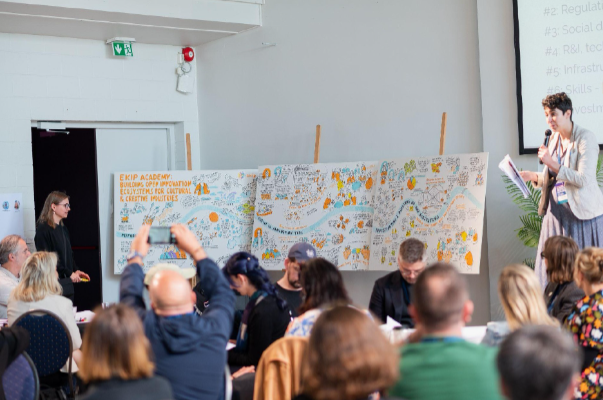
What the research says
This is not merely an impression from a room in Tallinn. There is a two-decade research literature on exactly this function. In a foundational 2006 paper in Research Policy, Jeremy Howells defined innovation intermediaries as organisations acting as agents or brokers between two or more parties in any part of the innovation process, and identified ten distinct functions they perform, from foresight and information processing to testing, standard-setting and commercialisation support. The point of the typology is that intermediaries are not a nice-to-have layer of facilitation on top of the “real” work. They operate across the entire innovation value chain.
The network research goes further. Ronald Burt’s influential 2004 study, “Structural Holes and Good Ideas”, examined where good ideas actually come from inside organisations, and found they are disproportionately produced by people whose networks bridge the gaps, the structural holes, between otherwise disconnected groups. Because opinion and behaviour are more homogeneous within groups than between them, the people who span those gaps see more options, see them earlier, and are practised at translating information from one world into another. Brokerage, in other words, is not the packaging stage of innovation. It is one of its primary engines.
Put the two bodies of work together and the Scottish team’s self-description stops sounding modest and starts sounding structural. Translators, mediators and connectors are not support staff for innovation ecosystems. On the evidence, they are where a significant share of the innovation originates.
Why the glue goes unfunded
And yet almost everything about how we organise and fund innovation works against this role. Budgets are annual; policy runs in cycles; funding wants, as Katarina put it, results without risk. Infrastructure spending flows to things that can be photographed, audited and cut in a ribbon, buildings, equipment, programmes. Intermediation is continuous, relational and, when it works, invisible. Nobody’s annual report has a line for glue.
The Academy itself offered a counter-example worth studying. The Basque District of Culture and Creativity describes its role explicitly as an intermediary, connecting CCIs with public policy, technology sectors and international networks, and feeding what it learns from the ecosystem back into policy design. That position did not appear by accident. It sits on more than a decade of groundwork, including a careful categorisation of the CCI subsectors, done with the sector rather than to it. Where intermediation has been institutionalised, named, resourced, given time, it works.
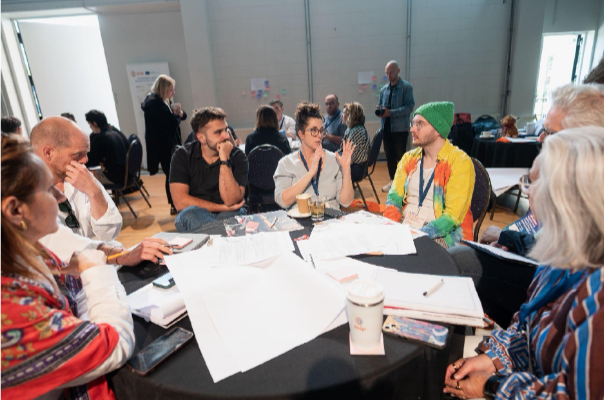
There was a quieter version of the same lesson in the Academy’s own design. Every team came as a trio: a policy maker, a creative entrepreneur, an innovation facilitator, three people from the same ecosystem who, in many cases, had never worked this closely before. The intermediation was built into the format. One participant, who works on the delivery side with no policy background, said the Academy made her feel included precisely because she could finally see how decisions are designed at the level above her: she knows what works and what fails on the ground, and until that week there had been no channel for that knowledge to travel upwards. That missing channel is the missing infrastructure, experienced from below.
Naming the function
One of the Academy’s facilitators put it plainly on camera: creatives are the sense-makers of this world, they are not here to decorate it. I would extend the claim. Sense-making between worlds, between a funding instrument and a festival director, between an innovation strategy and a dance company, between what a policy document says and what a practitioner can do with it, is not a soft skill that surrounds the real work of innovation. It is a load-bearing function, and ecosystems that lack it stay fragmented no matter how much talent or money they contain.
The practical implication is uncomfortable but clear. If translation, mediation and connection are infrastructure, they should be treated as infrastructure: named in strategies, funded continuously rather than project by project, and measured, which is, fittingly, exactly the problem the Scottish team came to the Academy to work on: impact measurement that captures what public funding actually does beyond the commercial metrics.
The Scottish Enlighteners gave the Academy its best metaphor, so let them have the last word too. Glue is never the part of the structure anyone admires. But remove it, and you find out very quickly what was holding everything together.
Katerina Kalimera attended the ekip Academy in Tallinn, 1-4 June 2026, representing MSCOMM, ekip’s communication lead.
References
● Howells, J. (2006)’Intermediation and the role of intermediaries in innovation’ Research Policy, 35(5), pp. 715–728.
● Burt, R.S. (2004) ‘Structural Holes and Good Ideas American Journal of Sociology, 110(2), pp. 349–399.
Latest ekip News and Updates

October 1, 2026
Europe has the pieces. In Eindhoven, ekip shows how to connect them.
On 23 October, during Dutch Design Week, three years of European work on the cultural and creative industries changes hands ...
September 17, 2026
By Michalis Stangos
Four things Europe needs to get right on the creative industries, and one that is still missing
Europe is losing the technology race, but it still leads on creativity. China used to recruit European engineers. ...
September 3, 2026
By Lena Holmberg, Lund University
AI and CCI: Shaping Europe’s Next Step
Across Europe, cultural and creative actors are asking a similar question: how can artificial intelligence be shaped in ways that strengthen creativity, cultural diversity and democratic innovation, r...

July 16, 2026
By Katerina Kalimera
Translators, mediators, connectors: the missing infrastructure of innovation
At the ekip Academy in Tallinn, the South of Scotland team described themselves as the “glue” forming sectors and enabling collaboration, a basic idea that stayed with attendees throughout the event....
