


 News,Policy Spotlights
ekip amplifies Creative Industries in Namibia–EU partnership talks
News,Policy Spotlights
ekip amplifies Creative Industries in Namibia–EU partnership talks
ekip amplifies Creative Industries in Namibia–EU partnership talks
By Bodil Malmström
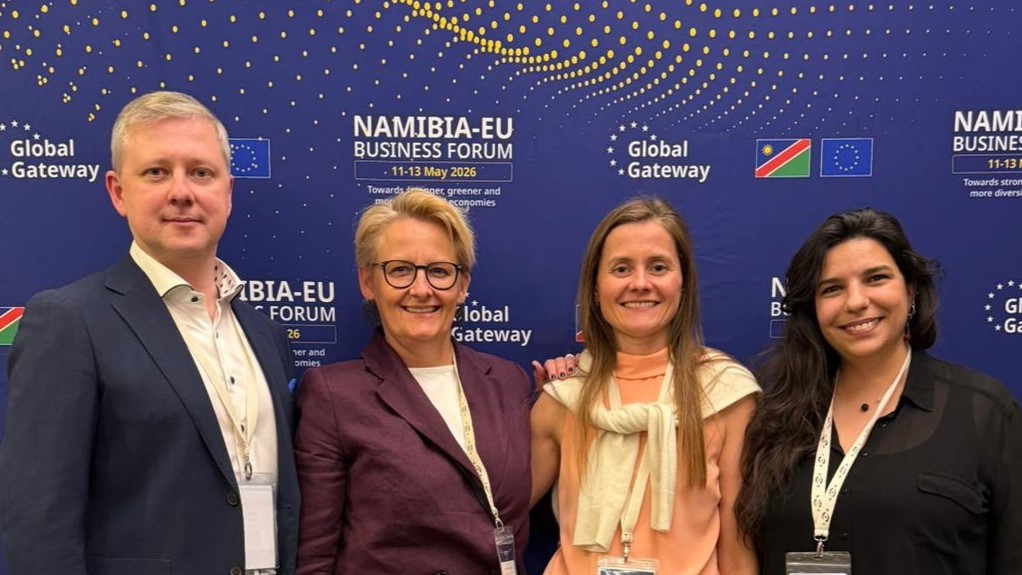
The Namibia–EU Business Forum 2026, held from 11–13 May in Windhoek, marked a significant step forward in strengthening economic cooperation between Namibia and the European Union. Building on the momentum of the inaugural 2023 edition, this year’s forum convened senior government officials, private sector leaders, development institutions, and financiers to explore concrete opportunities for trade, investment, and strategic partnerships.
Structured around six priority sectors—Green Hydrogen and Renewable Energy, Critical Raw Materials, Agribusiness, Creative Industries, and the Automotive Industry—the forum reflected a shared commitment to sustainable growth and economic diversification.
Notably, the creative industries emerged as a key area of dialogue, highlighting their growing importance in both regions’ economic and cultural landscapes. In this context, ekip played a visible and active role, contributing to discussions and ensuring that the creative sector was strongly represented in the broader Namibia–EU partnership framework.
Speech by Ragnar Siil, Director at Creativity Lab in Estonia and a partner of ekip.
Why Cultural and Creative Industries Matter for the EU
It is a real privilege to be here in Windhoek today, and to speak about something I genuinely believe is one of the most exciting topics on this Forum’s agenda: the cultural and creative industries.
Before I begin, allow me one personal note. Namibia, for any visitor from Europe, is an unforgettable place. This is my fourth visit to your beautiful country. I’ve had pleasure over the years to work with Namibian creative entrepreneurs, students, and policy makers to support the country’s creative potential. It is wonderful to be back. The people, the landscapes, the music, the craftsmanship, the stories — they all leave a mark. And that, in many ways, is exactly what we are here to talk about: how culture and creativity move people, move economies, and move countries forward.
Europe, a Creativity Superpower
Let me start with Europe.
When the European Union talks about its strategic priorities, you usually hear about the green transition, digital transition, security, competitiveness. But what is really embedded in all of this, is creativity.
The numbers tell a clear story. The cultural and creative industries today contribute around 4.4% of the EU’s GDP. They employ more than eight million people across Europe — that is more than the entire European automotive industry. It is more than telecommunications. In many of our countries, creative industries are now among the largest sources of employment for young people.
Music, film, design, fashion, video games, publishing, architecture, advertising, performing arts, heritage, crafts — these are not luxuries. They are industries. They produce, they export, they innovate, and they employ.
Now let us be honest about Europe’s place in the world. Europe is not a military superpower. We do not have the largest reserves of oil, gas, or critical minerals. We are not the biggest continent, and we are certainly not the youngest one.
But Europe is, without any doubt, a creativity superpower.
We are the home of more UNESCO World Heritage sites than any other region on the planet. We host the world’s most visited museums, the most performed composers, the most recognised architectural masterpieces, and some of the most influential design and fashion houses in history.
When the world watches a film, listens to music, plays a video game, picks up a book, opens a wine bottle, drives a car, or wears a piece of clothing — there is a very high chance that something European is involved.
That is soft power. That is brand. That is value. And that is why, for Europe, supporting the creative and cultural industries is not a “nice to have.” It is a strategic priority — for innovation, for competitiveness, and for our place in the world.
Creativity as a Catalyst for Innovation and Growth
And this brings me to my second point, which I think is the most important one to land in this room today.
For too long, we have spoken about culture as something that needs to be subsidised. As if culture were a cost — a beautiful expense, but an expense.
Investing in creative industries is not charity. It is not merely a cultural subsidy. It is, first and foremost, an investment — an investment that pays back, often many times over, across the entire economy.
Think about it for a moment. Every hotel that fills its rooms because of a music festival, a film shoot, or a heritage site — that is creativity at work. Every product that sells better because of good design, good branding, good storytelling — that is creativity at work. Every classroom that comes alive because of a great game, a great book, a great teacher with creative tools — that is creativity at work. Every patient who heals a little faster because of art therapy, music, or a thoughtful hospital design — that is creativity at work. Every rural village that finds new life because people can produce content, design, animation or music from their home — that, too, is creativity at work.
Culture and creativity touch tourism, education, technology, health and well-being, urban planning, and rural development. They are horizontal. They lift everything else up.
In Europe, the data to support this claim is striking. Creative inputs are embedded across the value chain — design and content add measurable value to industries from pharmaceuticals to advanced manufacturing. When a product is well designed, well branded, and well told, its margin can double, sometimes triple. The raw material is the same. The creativity is what changes the value.
And then, of course, we must talk about artificial intelligence.
We are living through the most profound technological shift since the arrival of the internet. AI is rewriting how content is made, how it is consumed, and how it is monetised. This is a moment of enormous opportunity, and a moment of real risk for creators.
If we get this wrong, we will hurt the very people whose work has trained these systems. If we get it right, AI becomes a tool in the hands of human creators, a powerful collaborator that lets a small studio in Windhoek compete with the biggest players in the world.
Europe’s position is clear: artificial intelligence must work with creators, not against them. It must respect copyright, reward authorship, and remain transparent. Because in an age when machines can generate almost anything, the value of an authentic human voice, a real cultural identity, an original story rooted in a real place, and that value goes up, not down.
And let us not forget: the World Economic Forum lists creativity among the most essential skills of the 21st century. Not coding. Not even AI. Creativity. The ability to see what isn’t there yet — and to bring it to life.
A Story from Estonia, for Namibia
And this leads me to my final point — and a more personal one. Because I also represent Estonia, I want to bring an Estonian perspective into this room. I do so deliberately, because I believe the Estonian story carries a message that matters far beyond Europe, including here in Namibia.
The message is simple: creativity is not the privilege of large countries, rich places, or big cities. It is not reserved for London, Paris, or New York. Creativity belongs just as much to small nations and remote places, to countries like Estonia, and to countries like Namibia.
Estonia is small. We are 1.3 million people. We sit on the north-eastern edge of Europe, with long winters and short summers. And yet Estonia has the most startups per capita in the world. The most unicorn companies per capita in the world. We are the birthplace of Skype. We are a country with one of the most advanced digital governments in the world. It’s a country where 99,9% of public services are online. It is the only country in the world where people can vote online in all elections. The most performed living composer on the planet today is Estonian — Arvo Pärt — whose music has been heard by hundreds of millions of people who could never find Estonia on a map.
How is that possible?
It is possible because we made a choice. We decided that, for a small country, culture and creativity are not optional. They are how we become bigger than our size.
In Estonia, the creative industries contribute 2.3% of GDP — about 2.5 billion euros. Our creative exports are over half a billion euros. And here is the most interesting number: in just five years, our creative sector grew its revenue by 37% — while reducing its workforce by 6%. That is digitalisation. That is productivity. That is a creative sector behaving like a high-tech sector.
Our most productive sub-sector — gaming and educational technology — produces more than twice the value added per employee of the Estonian average. Our visual effects studios, our animation houses, our designers, our musicians, our film-makers, they sell to the world from a country you can drive across in three hours.
We are now moving from doing creative work for others to owning what we create. From subcontracting to intellectual property. From service to value. We are building a dedicated export strategy for the creative industries, not as a side topic, but as core economic policy. And we are treating cultural heritage as a living resource. We digitise it, we reuse it, we license it.
This is the lesson I want to share with our Namibian friends today. Namibia is also a treasure box. A treasure box of stories, of landscapes, of languages, of crafts, of music, of history. A country with extraordinary natural beauty and an extraordinarily creative young population.
If a country of 1.3 million people in the north of Europe can become a global startup nation through culture, technology, and design, then a country with this much heritage and this much energy, here in southern Africa, can absolutely do the same. And in some areas, even better.
A Partnership of Co-Creation
That is why the European Union is here. We are interested in co-creation, co-production, joint ventures, and shared intellectual property. We are interested in bringing Namibian voices into European markets, and European know-how into Namibian companies.
In the end, this is not only about GDP. It is about how Namibia tells its story to the world, in its own voice, on its own terms, and at its true value.
Europe wants to be a partner in that story.
Latest ekip News and Updates
October 1, 2026
Europe has the pieces. In Eindhoven, ekip shows how to connect them.
On 23 October, during Dutch Design Week, three years of European work on the cultural and creative industries changes hands ...
September 17, 2026
By Michalis Stangos
Four things Europe needs to get right on the creative industries, and one that is still missing
Europe is losing the technology race, but it still leads on creativity. China used to recruit European engineers. ...
September 3, 2026
By Lena Holmberg, Lund University
AI and CCI: Shaping Europe’s Next Step
Across Europe, cultural and creative actors are asking a similar question: how can artificial intelligence be shaped in ways that strengthen creativity, cultural diversity and democratic innovation, r...
July 16, 2026
By Katerina Kalimera
Translators, mediators, connectors: the missing infrastructure of innovation
At the ekip Academy in Tallinn, the South of Scotland team described themselves as the “glue” forming sectors and enabling collaboration, a basic idea that stayed with attendees throughout the event....
